
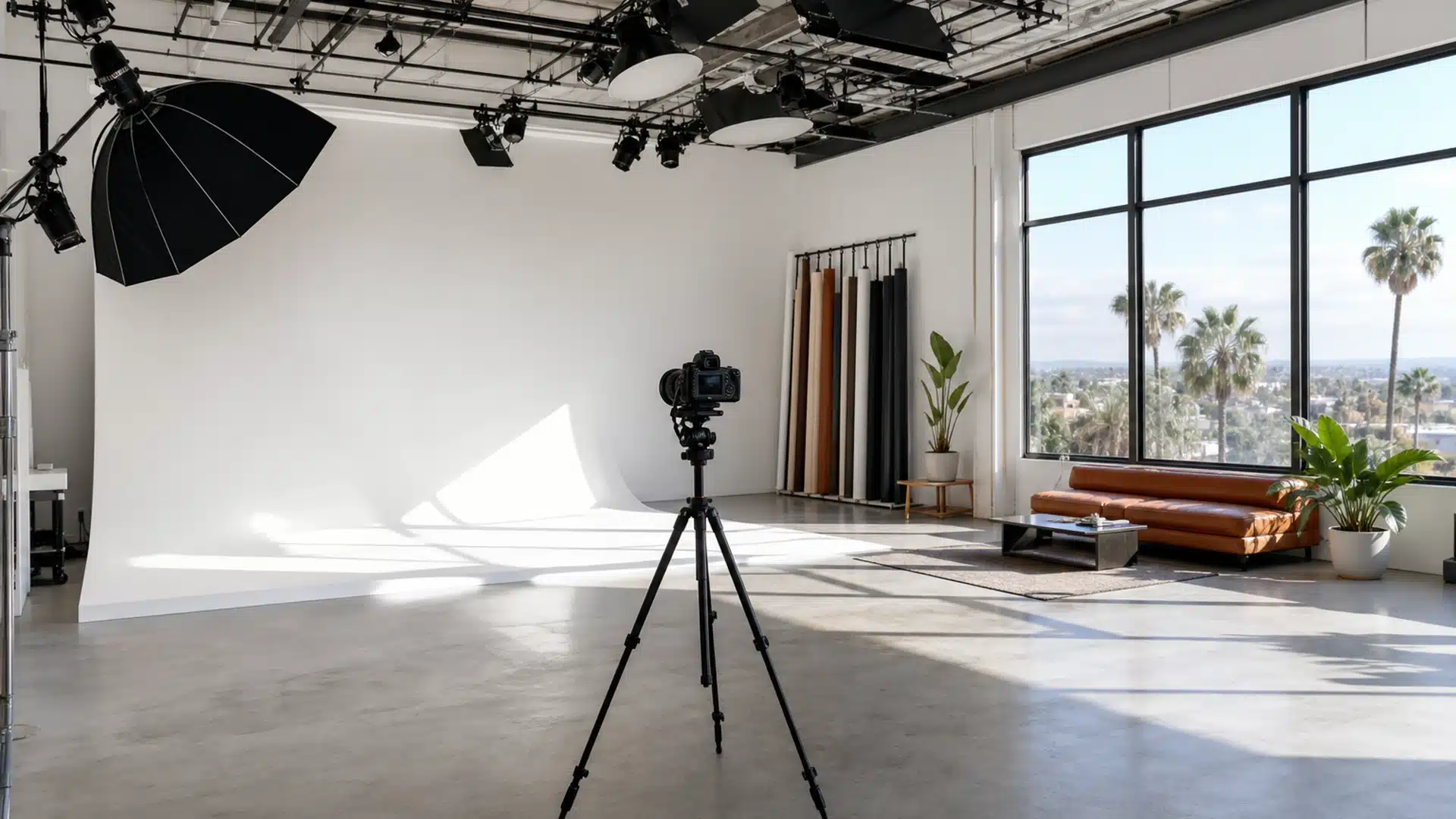
An hourly studio rental is the simplest way to level up your production quality without signing a lease or taking out a loan. You book the space when you need it, show up with your camera and your shot list, and everything else — the lighting, the backdrops, the infrastructure — is already there waiting for you. It is the model that working photographers, videographers, content creators, and production teams reach for when the project demands a professional environment but the budget does not include a permanent studio of their own.
The numbers back this up. The global photography studio industry is worth roughly $37 to $46 billion in 2025, and well-managed studios consistently hit 50% to 70% gross margins by providing exactly what creatives need — flexible, equipped space — without the overhead bloat. Whether you are shooting a commercial campaign, a music video, product photography, or the kind of creative work that just can not happen in your living room, understanding how an hourly studio rental actually works changes the math on every project you book.
What Is an Hourly Studio Rental — and Who Is It For?
An hourly studio rental is a pay-as-you-go production space. You reserve the studio for a set number of hours — usually with a 2- to 4-hour minimum — and during that block the space and its equipment are yours. No lease. No deposit beyond the booking fee. No storage fees or monthly overhead. Show up, shoot, wrap, leave. It is the difference between owning a venue and buying a ticket.
The appeal cuts across a surprisingly broad range of creatives. Freelance photographers who do commercial work three days a month can not justify a permanent lease — and should not have to. Videographers shooting brand films or music videos need access to professional lighting and backdrops for a single production day, not a year. Content creators and influencers want a controlled, well-lit environment that does not look like a corner of their apartment. Production companies occasionally need overflow space when the main studio is booked. E-commerce brands shooting seasonal product catalogs need clean, consistent backdrops without building them from scratch every quarter.
The common thread? These are professionals who need a studio sometimes, not always. The hourly model is what makes that viable. For most of them, an hourly studio rental is not the budget option — it is the smarter business decision.

What Is Actually Included in an Hourly Studio Booking?
One of the biggest misunderstandings about studio rentals comes down to what the rate actually covers. Some studios quote a base rate that includes the space and nothing else — every light, every backdrop, every modifier comes at an additional charge. Others run an all-inclusive model where the quoted hourly rate covers the full equipment suite. The difference can double or halve your effective cost before you have even set up your first stand.
A professional hourly studio rental generally includes studio-grade strobes or continuous LED panels, light stands, softboxes, and umbrellas; multiple sweeping paper backdrops or muslin options; basic grip equipment like C-stands, sandbags, and clamps; a tethering station or client monitor for reviewing shots; a changing room or green room for talent; and full climate control and power distribution throughout the space. Studios with cyclorama walls — the clean curved wall-to-floor transitions used in fashion, product, and automotive photography — command higher rates because they are expensive to build and maintain.
When you rent a photo studio, you can usually choose to rent it by the hour, half-day, or full-day as per your requirement. These studios let you work in a space specifically designed for production, complete with professional lighting, backdrops, and accessories that would cost thousands to buy and store. That is the real value proposition: access, not ownership.
Always request an itemized list of what is included before you book. A studio that looks cheaper on its website can easily cost more than a premium space once equipment fees enter the equation — and with an hourly studio rental, those fees can add up fast if you are not paying attention.
How Much Does an Hourly Studio Rental Cost?
Studio rental rates span a wide band, from roughly $25 per hour for a basic shared space to $300 and up for premium studios in major markets. Where you land on that spectrum depends on three things: city, square footage, and what is actually included in the rate.
In major cities like New York, Los Angeles, and San Francisco, standard hourly studio rental rates run $75 to $200 per hour for a professionally equipped space. Mid-sized cities like Austin, Denver, and Nashville typically fall between $50 and $125. In smaller markets, well-equipped studios often run $40 to $75 per hour. Studio rental costs fluctuate based on location and amenities, with major cities commanding $50 to $200 per hour while smaller towns offer more budget-friendly options.
Beyond geography, the type of studio matters enormously. A minimalist daylight studio with one plain backdrop and limited equipment costs less than a full production facility with a cyclorama wall, multiple lighting grids, a kitchen set, and professional-grade audio treatment. The space you pick should match the shoot you are doing — paying for features you do not use is just as wasteful as booking a space that can not deliver what the project needs.
The floor requirement matters too. Most studios enforce minimum booking windows — 2 hours for quick headshot sessions, 3 to 4 hours for standard shoots. At $75 per hour with a 3-hour minimum, your entry point is $225 before any equipment upgrades or overtime. For anyone new to the hourly studio rental model, that minimum is the single most important number to check — it sets your real entry cost. Factor that into your planning from the start.
A few more pricing realities worth knowing: weekday rates typically run 15% to 25% lower than weekend rates, so a Tuesday shoot saves real money over a Saturday booking. And overtime is almost always charged at 1.5x the standard hourly rate. A 3-hour booking at $75 per hour that stretches 45 minutes over tacks on roughly $112. Budget accordingly.
Hourly vs. Full-Day Rentals: How to Decide
The math that actually matters: the break-even point between hourly and full-day studio rental is consistently around 7 hours across most U.S. markets. If your shoot needs more than 6 hours, the full-day rate is almost always the better deal.
Full-day rates in most markets run $400 to $1,200 for an 8- to 10-hour block — typically a 10% to 20% per-hour discount compared to booking those same hours individually. Overtime on a full day still runs at 1.5x the standard rate, but you are starting from a lower effective per-hour number.
So what does 7 hours of shooting actually look like? A commercial product shoot where you need to style, light, and capture 15 items across three setups. A music video production with a single location, a 5-person crew, and the ambition to shoot multiple angles and B-roll. A fashion editorial with outfit changes, lighting adjustments between looks, and enough time to experiment rather than just execute. For headshots, mini shoots, quick product captures, or any session you can finish in under 3 hours, the hourly model wins every time. It is cheaper and you do not pay for hours you do not use.
The decision is ultimately about certainty. If you know your timeline cold — you have done this type of shoot before, you have a locked shot list, your subjects arrive on time — book hourly and save. If anything about the day has variables (new client, first-time crew, ambitious shot count, talent you have not worked with), the full-day rate buys you breathing room. Rushing through a shoot because your time expired ruins the work.

Choosing the Right Studio for Your Shoot Type
Not every studio is built for every kind of work. Booking the wrong space is like renting a warehouse to cook dinner — technically possible, but you will hate the process and the results.
For fashion editorials and commercial shoots, prioritize ceiling height and cyclorama access. A 14-foot ceiling gives you room to light from above and pull back for full-body shots. A cyclorama wall — the clean curved transition from wall to floor — makes background removal effortless and creates the clean, infinite-space look that commercial clients expect. For small teams of 3 to 6 people, target at least 1,000 square feet — enough for the subject area, the lighting rig, a staging table, and space for the crew to move without tripping over stands. Renting a photography studio gives photographers unparalleled control over lighting and environment in a way that on-location shoots simply can not match.
Headshot photographers and corporate shooters need less square footage but more control. A 500-square-foot studio with one reliable lighting setup, a few backdrop options, and a comfortable client area serves better than a massive warehouse with no light control. Natural window light is a bonus here — especially in morning sessions — because it creates the soft, approachable look corporate and acting clients want.
Content creators and video producers have different requirements entirely. You want continuous LED lighting (not strobes), reliable Wi-Fi for music streaming and file transfer, sound treatment so you are not picking up street noise on every take, and enough power distribution to run lights, monitors, and charging stations simultaneously. A production kitchen is a huge plus if food content or YouTube cooking videos are in your rotation.
Also think about timing and light. Consider how the time of day will affect the overall vibe in the studio, along with your photos. A lot of studios have windows, and natural lighting can drastically change the shadows, highlights, and tones within an image. Find out where exactly the sun will be during your booked hours before you commit to anything.
How to Maximize Every Minute of Your Studio Time
The biggest mistake first-time renters make? Treating studio time like an open-ended creative exploration. It is not. The clock is running whether you are shooting or scrolling through reference images on your phone. When you are working with an hourly studio rental, every minute counts — and every minute you spend deciding what to shoot next is a minute you are paying for.
Plan in reverse. Start from your wrap time and build backward. The studio closes at 6 PM and you need 45 minutes to tear down and pack out — you stop shooting at 5:15. Four setups means roughly an hour per setup with transitions. That is your shot list right there, not four hours of “figure it out as we go.”
Arrive with a shot list and a lighting plan. You do not need a storyboard for every angle, but you should know what the first frame of each setup looks like before you walk through the door. Plan ahead, come prepared with shot lists and equipment requirements, use your time wisely by minimizing setup and teardown delays, and take advantage of the studio’s resources and space. That is not generic advice — it is the difference between leaving with everything you needed and leaving with excuses. Every minute of an hourly studio rental is a minute you are paying for, so treat the clock like it costs money. It does.
Pre-light if possible. Some studios let you arrive 15 to 30 minutes early to set up lighting before the clock officially starts. Ask about this during booking. Even a 15-minute head start on lighting your first setup changes the momentum of the entire shoot.
Batch your setups by lighting configuration, not by shot order. If three product shots use the same key light and backdrop, shoot them back to back even if they are destined for different clients. Changing lighting rigs eats 10 to 20 minutes per transition. Cut those transitions and you buy yourself an extra half hour of actual shooting.
Build in a buffer. At least 15 minutes at the end of your booking for unexpected delays, talent needing a break, or that one shot you did not plan but suddenly need. A 15-minute buffer is the cheapest insurance on your production day.
Questions to Ask Before You Book
Most studio booking disappointments trace back to a question nobody asked. Here are the ones that actually matter.
What is the exact equipment list — and is everything included in the base rate? Some studios advertise “professional lighting included” but charge separately for modifiers, backdrops, and grip equipment. Always request a detailed breakdown of the base rate inclusions. Some studios incorporate basic lighting equipment in the rate; others charge extra for each item. Get the list in writing before you sign.
What is the cancellation and rescheduling policy? Clients reschedule. Talent gets sick. Weather ruins outdoor call times that bleed into studio time. Know whether you can move your booking without penalty, and how much notice the studio requires.
Is there a COI requirement? Many professional studios require a Certificate of Insurance, and it is not something you can generate the morning of your shoot. If you are a freelancer without commercial liability insurance, you may need to secure coverage before booking. Studios that accept COIs are generally working at a professional level — it is a signal, not a hassle.
What is the overtime rate and how strictly is it enforced? Some studios are generous with a 10-minute grace period. Others start charging overtime the moment your booking ends. Know which you are walking into. Overtime at 1.5x the standard rate is standard — at $75 per hour, a 45-minute overage costs about $112.
Can I see the space in person before booking? Website photos are curated. Shadows, tight corners, and awkward power outlet placements do not show up in wide-angle real estate shots. If the studio allows walkthroughs, take one. If not, ask for a video tour or raw phone photos of the exact setup.
What is the parking and load-in situation? A beautiful studio on the third floor of a building with no freight elevator and street-only parking is a logistical nightmare if you are hauling C-stands, sandbags, and three cases of lighting gear. Check the load-in path before you book — it is as important as the studio itself.
Why Renting Beats Building Your Own Studio
It is a fantasy a lot of working creatives entertain: sign a lease, build out the space, and never worry about booking windows or equipment rental fees again. The reality is less romantic. Average small-studio operating costs run $75,000 to $180,000 per year — rent, utilities, gear acquisition and maintenance, software subscriptions, marketing, insurance, and the hours you spend managing a facility instead of shooting.
An hourly studio rental flips that equation completely. You pay for production capacity when you need it, and exactly zero when you do not. The photography studio market is projected to reach $64 to $82 billion by 2032, and the studios winning in that market are the ones offering flexible access — not forcing creatives into commitments they do not need.
There is also the equipment math. A professional lighting kit with strobes, softboxes, C-stands, and modifiers costs $3,000 to $8,000 to own outright — and you are responsible for storage, transport, maintenance, and eventual replacement. Renting a studio that includes that equipment in the booking rate turns a capital expense into a line item on a single shoot. You get access to gear you would never buy yourself, which makes it possible to experiment with diverse setups and achieve effects that would otherwise mean a trip to the rental house.
The flexibility matters too. An hourly studio rental adapts to your workload — not the other way around. Your needs change shoot to shoot. A headshot session needs 500 square feet and one good light; a fashion editorial needs 14-foot ceilings, a cyclorama, and room for a stylist, makeup artist, and client monitor. Building a single space that covers both scenarios costs six figures. An hourly studio rental — picking the right space for each project — costs what the project earns.
For the vast majority of working photographers, videographers, and content creators, renting is not the compromise — it is the strategy. An hourly studio rental is what turns unpredictable freelance income into predictable production overhead. You pay when you work. That is it. It keeps overhead at zero, equipment access current, and creative flexibility intact. Lightz Out Studios in San Diego is built for exactly this model: an 1,800-square-foot professional production space with a cyclorama wall, a full production kitchen, and professional-grade lighting and backdrops available by the hour or by the day — no lease, no long-term commitment, no overhead.
Frequently Asked Questions
How long should I book a studio for?
The booking length depends on your shoot type. Headshots and quick product captures can wrap in 2 to 3 hours. Fashion editorials, commercial shoots with multiple setups, and any project involving hair and makeup talent generally need 4 to 6 hours. Video production almost always warrants a full-day booking — setup, multiple takes, lighting adjustments, and B-roll add up fast. The length of your booking depends entirely on the type of shoot, so estimate generously. Running out of time mid-shoot costs more in overtime than an extra booked hour would have in the first place.
What is the difference between a photography studio and a video production studio?
Photography studios are optimized for still-image work — strobe lighting, sweeping paper backdrops, tethering stations, and quick-change modifier setups. Video production studios prioritize continuous LED lighting, sound treatment to control echo and external noise, reliable power distribution, and enough clear floor space for camera movement, dollies, and multiple monitoring stations. Some professional studios — including facilities with cyclorama walls and production kitchens — handle both, but always confirm the specific equipment list for your format before booking.
Do hourly studio rentals include equipment?
It varies by studio. Some operate an all-inclusive model where lighting, stands, backdrops, and modifiers are part of the base rate. Others charge separately for equipment packages. Always request an itemized list of what is included and what costs extra. An hourly rate of $50 that requires $75 in equipment add-ons is effectively more expensive than an $85 rate with everything included.
Can I tour a studio before I book?
Most studios welcome walkthroughs, especially for first-time renters. A tour lets you verify ceiling height, power outlet locations, natural light at different times of day, load-in logistics, and the actual condition of the equipment — things that polished website photos do not always capture. If an in-person visit is not possible, ask for a video walkthrough or recent phone photos of the exact setup you would be using.
What happens if I go over my booked time?
Almost all studios charge overtime at 1.5x the standard hourly rate, calculated in 15- to 30-minute increments. A 3-hour booking running 45 minutes over at $75 per hour costs roughly $112 in overtime. Some studios enforce a hard stop time with no grace period; others offer a 5- to 10-minute buffer. Know the policy before the shoot and plan your wrap accordingly. Building a paid 15-minute buffer into your booking is cheaper than unplanned overtime.
Do I need insurance to rent a studio?
Many professional studios require a Certificate of Insurance (COI) naming the studio as additionally insured. This is standard practice at the commercial level — it protects both you and the studio in case of equipment damage, property damage, or injury. If you are a freelancer without commercial liability coverage, plan ahead: securing a policy can take a few days, and you cannot generate a COI the morning of your shoot. The COI requirement is generally a signal you are booking at a professional-grade facility.
If you are ready to book a professional studio in San Diego, Lightz Out Studios gives you the full package — a cyclorama wall, production kitchen, professional lighting, and a flexible open floor plan in an 1,800-square-foot facility available by the hour or full-day block. Check out the headshots page to see what a professional studio environment can do for your work, or get in touch with the team to check availability and ask any questions about the space, the equipment, or your specific production needs.

