
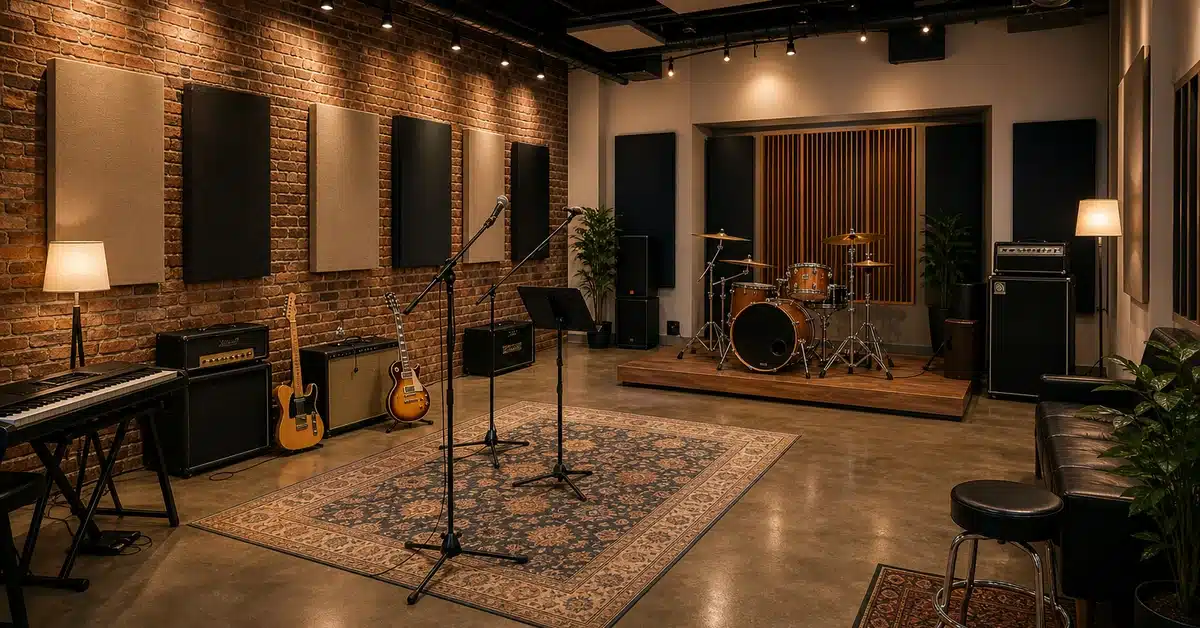
Finding a music studio rental space that actually works for your needs isn’t as simple as booking the first room that shows up on Google. Between hourly rates, monthly lockouts, equipment quality, and acoustic treatment, the gap between a mediocre room and a space that elevates your sound is genuinely wide. For musicians, producers, and bands who’ve outgrown the bedroom setup or simply need a professional environment without the six-figure buildout, knowing what separates a real studio from a converted storage unit changes everything.
What to Look for in a Music Studio Rental Space
Not all rental studios are created equal. Some are acoustically treated, professionally equipped creative hubs. Others are empty rooms with a couple of foam panels stapled to the wall and an ancient PA that crackles every third song. Here’s what actually matters.
Acoustics and Sound Treatment
This is the single biggest thing that separates a real studio from a loud room. Proper acoustic treatment means bass traps in the corners, absorption panels at first reflection points, and diffusion where it counts. Not foam squares in random patterns. Not egg cartons. You want a space where you can hear what you’re actually playing — not the room’s opinion of what you’re playing.
Studios like Band Barracks in Houston build their rooms with specially constructed walls for maximum sound dampening and customized doors that prevent sound bleed between spaces. Octagon Studios in London takes it even further — their rooms achieve in excess of 70 dB Dw isolation between studios with energy decay curves smooth down to 30 Hz. That’s the kind of spec that tells you the builders actually understood what they were doing.
When touring a potential rental space, clap your hands. Listen. If the room rings or echoes, it’s untreated. If the sound dies cleanly, you’re in the right place.
Equipment and Backline
The whole point of renting a studio instead of rehearsing at home is access to gear you don’t own — or gear you don’t want to haul across town. A solid rental space should include a functioning drum kit (not just a kick drum with a ripped head), bass and guitar amps that don’t hum, a PA system with enough channels for your setup, and at least basic microphone options.
Some studios bundle everything into the rate. Lockout Music Studios, with locations across California and Nevada, includes a full PA system, drum kit, bass amp, and guitar amp in their hourly rate. Complete Music Studios in Brooklyn offers full backline in 350-square-foot rehearsal rooms and a production suite with lounge, bathroom, mix room, and kitchenette for longer-term lockouts.
Walk through the gear list before you book. Call the studio if the website is vague. A room with bad equipment is worse than no room at all — it will fight you the entire session.
Space and Layout
Square footage matters, but layout matters more. A 500-square-foot rectangular room with a low ceiling is going to sound boxy no matter what you put in it. A slightly smaller space with 12-foot ceilings and a sensible shape will breathe.
Room sizes vary dramatically across the market. Band Spaces NYC offers solo rooms as small as 6×5 feet — fine for a songwriter with a keyboard — up to full band recording spaces at 14.25×8.75 feet. Lockout Music Studios ranges from 55-square-foot individual practice rooms to 1,400-square-foot rehearsal spaces. The Record Shop in Nashville features a 650-square-foot tracking room with 16-foot ceilings, three isolation booths, and capacity for up to 40 people.
Think about your specific needs. A jazz trio doesn’t need what a seven-piece metal band needs. A producer tracking vocals doesn’t need what a full band running a rehearsal needs. Match the space to the session, not the other way around.

How Much Does It Cost to Rent a Music Studio? (By City and Studio Type)
The music studio rental space market spans a genuinely wide price range. You can spend $20 an hour or $3,000 a month — and both prices can be fair, depending on what you’re walking into.
Hourly Rates
For musicians who need occasional access — a few rehearsals before a show, a weekend recording session — hourly rentals are the most flexible option. Lockout Music Studios starts at $20 per hour with a 3-hour minimum, which includes full backline. Sounds Like Soma in Philadelphia offers Studio C at $30 per hour, with day rates at $150, weekly at $450, and monthly at $900 — a pricing ladder that rewards commitment.
At the higher end, studios in competitive markets like New York and Los Angeles run $50 to $100 per hour for rooms with premium gear and engineered acoustics. The rate almost always correlates with what’s in the room. A $20 room with a full backline can be a better deal than a $60 room with nothing but four walls and an outlet.
Monthly Lockout Pricing
The lockout model — where you get a private, 24/7-accessible room on a monthly lease — has reshaped the market in the last decade. Musicians who rehearse multiple times per week, producers who need a consistent creative base, and bands recording an album over several months all benefit from this model.
Pricing varies heavily by city. Francisco Studios in Los Angeles — serving LA musicians since 1985 — offers month-to-month rentals starting as low as $450 per month with 24/7 exclusive access, electricity, and wifi included. No long-term contracts. On the other end of the LA market, LemonTree Studios provides private lockout studios from $2,000 per month in the Arts District to $2,950 per month in Highland Park — Dante-networked live rooms, master-crafted acoustics, purpose-built for working producers and engineers.
In New York, The Music Building has been the largest rehearsal complex in NYC since 1979, with 69 studios exclusively leased to musicians on a monthly basis and 24/7 access. Band Spaces NYC requires a minimum 3-month stay with month-to-month after that — a middle ground between short-term hourly and long-term lockout.
Across the Atlantic, Octagon Studios London rents production studios from 8 to 29 square meters starting at £800 per month, while Sensible Music leases its premier production suite at £2,250 per month (dropping to £2,000 on a 6-month commitment). The UK market is heavily concentrated — 44.9% of all music studios are in London and the South East, rising to 63.5% when you include the entire South of England, according to a UK government market assessment by the Department for Digital, Culture, Media & Sport.
Studio Rental vs. Home Studio: The Real Cost Comparison
The appeal of a home studio is obvious — no commute, no booking calendar, no hourly meter running. But the math changes fast once you start pricing out what a real home setup costs versus what a rental gives you immediately.
Building a treated room from scratch is expensive. Acoustic panels alone can run $500 to $2,000 depending on room size. Bass traps, diffusion panels, proper monitoring — $2,000 to $5,000 before you’ve bought a single instrument. And that’s assuming you already have the space. In cities like New York, San Francisco, or Los Angeles, the square footage alone makes a dedicated home studio a luxury most musicians can’t justify.
Renting eliminates every one of those costs. You walk into a professionally treated room with gear already set up, you play, you leave. No sound complaints from neighbors. No $300 repair when the PA blows. No spending your Saturday installing acoustic foam instead of making music.
The rental model also fundamentally shifts equipment costs from capital expenditure to operational expense — a distinction that matters when cash flow is tight. A professional studio space like Shifted Recording in Brooklyn provides everything from microphones and monitors to recording gear and backline — gear that would cost tens of thousands to acquire, maintain, and store. For $20 to $100 an hour, you access equipment that would take years to assemble on your own.
There’s also the creative factor that doesn’t show up on a spreadsheet. Home studios are isolating. Rental studios put you in a building with other musicians — producers down the hall, a drummer you might collaborate with next month, an engineer who overhears your session and offers to mix it. The 2025 Cedar Rapids Music Census found that 50% of surveyed musicians are actively seeking collaboration spaces. You can’t get that from a laptop in your living room.

The Rise of 24/7 Lockout Studios
The lockout model isn’t new — The Music Building in New York has been doing it since 1979 — but it’s accelerating. Musicians want unfettered access. No booking windows. No “sorry, the room is taken from 4 to 6.” Just a key and the freedom to work whenever the creative impulse hits.
Band Spaces NYC runs 24/7 private monthly studios across multiple Brooklyn locations, with room sizes from solo practice spaces to full band recording rooms. The minimum commitment is 3 months, with month-to-month after that — a structure that gives musicians stability without handcuffing them to a year-long lease they might regret.
The monthly model works because it aligns incentives. The studio operator gets predictable revenue. The musician gets a home base. And when a space feels like yours, you use it more. A monthly lockout isn’t just a room — it’s a creative headquarters.
This model has spread well beyond New York and LA. BQE Studios in New York positions its rental spaces as a direct upgrade from home recording — immediate access to professional microphones, monitors, and recording gear that would be impractical or impossible to own individually. The pitch is straightforward: stop compromising on sound quality because your apartment has thin walls.
How Professional Acoustics and Gear Access Elevate Your Sound
Let’s be blunt about something. A great performance captured badly sounds worse than an okay performance captured well. The reverse is also true: a decent take in a properly treated room with good mics can sound fantastic.
Professional studios invest in things most musicians can’t. Room tuning isn’t just throwing up panels — it’s measuring frequency response, placing treatment at mathematically calculated reflection points, and balancing absorption against diffusion so the room sounds alive without ringing. Studios like Octagon London don’t just say their rooms are soundproofed — they specify the isolation rating (70 dB Dw) and the frequency response curve (smooth to 30 Hz). That level of precision changes how a recording translates across playback systems.
The gear gap is even starker. A single high-end condenser microphone — a Neumann U87, a Sony C-800G — costs more than six months of rental fees at most studios. A professional studio’s mic locker, preamp collection, and outboard gear represent an investment that would be financially irresponsible for a single musician to replicate. Rental makes that gear accessible on a per-session basis. It’s the difference between recording through a $200 interface in an untreated bedroom and tracking through a Neve console into Pro Tools HDX in a room designed for the purpose.
The industry data backs this up. The sound recording studios market reached $1.7 billion in 2025 according to Kentley Insights, with 5.2% annual growth over the prior three years. Studio rental and leasing revenue specifically — the segment most relevant to musicians booking space — hit $61 million in 2022, a 27% jump from the $48 million recorded in 2021, per the U.S. Census Bureau. More musicians are choosing to rent rather than build, and the numbers show it.
Even at the community level, the demand signal is unmistakable. Beyond the Cedar Rapids census finding that half of musicians want collaboration spaces, 47% want access to music industry services and 42% are looking for networking opportunities. A good rental studio isn’t just a room with good acoustics — it’s a node in the local music ecosystem.
Frequently Asked Questions About Music Studio Rental Spaces
How much does it cost to rent a music studio space?
Hourly rates range from $20 to $100 depending on the city, room size, and included equipment. Monthly lockout studios start around $450 per month and can reach $3,000 for premium spaces in major markets. Most studios offer tiered pricing that gets cheaper per-unit with longer commitments.
What equipment is typically included in a studio rental?
Standard inclusions vary by studio but commonly cover a drum kit, bass and guitar amplifiers, a PA system with microphones, and basic monitoring. Higher-end studios include recording interfaces, outboard gear, and microphone lockers. Always confirm the equipment list before booking — some rooms are gear-inclusive, others are just the room.
What’s the difference between hourly and monthly lockout studios?
Hourly studios are booked per session — you reserve time, show up, and leave. Monthly lockouts give you a private, key-access room available 24/7 for a flat monthly rate. Lockouts work best for musicians who rehearse or produce several times per week. Hourly rentals suit occasional needs or musicians who want to try different rooms.
Do I need to bring my own instruments to a rental studio?
It depends on what you need. Most studios provide backline basics — drums, amps, PA — but specialty instruments and personal gear like guitars, pedals, cymbals, and snare drums are typically the musician’s responsibility. If you need something specific, call ahead and ask. Studios with deeper gear inventories can often accommodate special requests.
How do I know if a studio has good acoustics before booking?
Tour the space in person whenever possible. Clap test the room — listen for flutter echo and ringing. Ask about acoustic treatment specifics: bass traps, absorption panel placement, and isolation ratings between rooms. A studio that can’t explain its treatment probably didn’t do much. Studios that publish technical specs like dB isolation and frequency response curves are usually the real deal.
Can I record in a rental music studio space?
Absolutely. Many rental studios are built for both rehearsal and recording. Look for spaces with recording-ready infrastructure — an isolated control room or at minimum a DAW setup with an interface and monitors. Studios like The Record Shop in Nashville and Complete Music Studios in Brooklyn are designed specifically for hybrid rehearsal and tracking use.
Whether you’re tracking an album, rehearsing for a tour, or just need a room that sounds better than your garage, the right studio rental changes how you work. It eliminates every variable that distracts from the music — bad acoustics, missing gear, noise complaints, cramped quarters — and leaves you with one thing to focus on. What you’re making.
The market is deeper than it’s ever been. Hourly, monthly, bare-bones, fully loaded — there’s a music studio rental space that fits your budget and workflow, in nearly every major city. The key is knowing what to look for, what you actually need, and what a fair price looks like in your market. Whether you’re a solo producer who needs a quiet room with good monitors or a seven-piece band that needs enough square footage to breathe, the right room exists. And it’s probably closer — and more affordable — than you think. Walk through a few spaces, talk to the musicians already working there, and trust your ears. A great room announces itself the moment you walk in.
For San Diego musicians and producers, a professionally equipped production studio with flexible hourly and full-day rates makes the entire process simpler — book the hours you need, show up, and get to work in a space designed for exactly that purpose.
It eliminates every variable that distracts from the music — bad acoustics, missing gear, noise complaints, cramped quarters — and leaves you with one thing to focus on. What you’re making.

