
Landing on the right production company music video partnership isn’t just about who owns the most cameras. It’s about finding a team that understands your sound, your audience, and the specific energy you want on screen — then executing it without burning your budget or your patience. With the global music video production market valued at $9.4 billion in 2025 and projected to reach $18.7 billion by 2034, more artists are putting real money behind visual storytelling than ever before. The question isn’t whether you need a video. It’s whether you’ll pick the right people to make it.
According to Verified Market Research, the music video production market reached $11.2 billion in 2024 and is forecast to hit $20.39 billion by 2032 — growing at a 7.8% CAGR. North America alone commands roughly 34.6% of global production revenues. The numbers tell a clear story: visual content is no longer optional for artists who want to build a career. It’s the centerpiece.
Here’s what actually matters when you’re hiring a production company music video team — and what most artists overlook until it’s too late.
What Separates a Great Production Company Music Video Team from the Pack
A production company’s reel is their resume. Full stop. You’re not hiring a camera. You’re hiring taste, judgment, and the ability to make creative decisions under time pressure. Watch their portfolio with the sound off first — if the visuals hold your attention without the track, the director knows what they’re doing.
Genre alignment matters more than most artists realize. A team that nails glossy pop visuals may struggle with the raw, handheld energy a hip-hop video demands. A production company music video portfolio heavy on performance-based shoots might not be your best bet if you’re picturing a narrative short film with a script, actors, and location changes. Look for work that feels like it could live next to yours — same energy, same production scale, same visual language. If everything in their reel looks like a high-budget label production and you’re working with an independent budget, that mismatch will show in the final product.
Beyond the reel, pay attention to what’s not on screen. Does the company handle pre-production planning, location scouting, and post-production in-house? Or are they really just a camera operator who subcontracts everything else? The difference shows up in your timeline and your final product.

The Questions That Reveal Everything Before You Sign
Most artists walk into a discovery call with one question: “How much?” That’s the wrong opener. Cost means nothing without context. Here are the questions that actually surface the information you need — the ones the best companies welcome and the worst ones dodge.
Ask about their timeline from concept to final delivery. A music video isn’t a weekend project. Image Studio’s filmmaker workflow guide maps out a complete production pipeline from treatment through distribution — and it makes clear that skipping any phase creates problems downstream. A production company that can’t give you a straight answer about their timeline probably doesn’t have one.
Ask what’s included. Does the quote cover a director, DP, lighting tech, and grip? Or just the studio space and a camera? Are revisions built in, or will you be negotiating every change? One of the industry’s most cited checklists, published by Pixelab Studios, covers ten specific questions around timeline, budget transparency, and creative alignment — each one worth asking before you commit.
And ask what happens if something goes wrong. Equipment fails. Weather turns. A key crew member gets sick. A professional production company music video team has contingency plans for all of it. If the answer is “that won’t happen,” find someone else.
Red Flags You Shouldn’t Ignore
The production company that promises everything for nothing. The one that can’t show you more than two recent projects. The one that won’t let you talk to the director before signing. These aren’t quirks — they’re signals. Trust them.
Why the Director-Producer Dynamic Matters More Than the Gear
Cameras are commodities. LED panels and C-stands can be rented by anyone with a credit card. What separates a forgettable music video from one people share is the creative partnership between you, the director, and the producer running the logistics.
Ditto Music’s guide to commissioning a director nails the core dynamic: good directors want creative input — they’re not just technicians executing your shot list. If you walk into a treatment meeting and the director doesn’t have ideas of their own, you’ve hired a camera operator, not a collaborator. The best directors elevate your concept, they don’t just film it.
The producer, meanwhile, is the person who makes sure the shoot actually happens. They’re booking the space, wrangling the crew, managing the schedule, and handling the thousand small crises that arise on any production day. A weak producer means the director spends half the shoot solving problems instead of directing. You’ll see it in the final cut.

What Music Video Production Actually Costs in 2026
The numbers have shifted dramatically. Neverframe Studio’s 2026 Cost Guide reports that a music video costing $60,000 to produce in 2019 can now be made for under $10,000. The reason isn’t cheaper labor — it’s democratized technology. Cameras that once required a rental house now fit in a backpack. Editing software that used to demand a post-house budget runs on a laptop.
This doesn’t mean you should aim for the cheapest option. It means the budget conversation has fundamentally changed. Production services still dominate at 42.3% of market share — the on-set work is where the money goes, and that’s where it should go. A sharp idea shot on modest gear will outperform a weak idea shot on an ARRI Alexa every time. The industry has shifted from “how much can you spend” to “how well can you execute.”
The broader market reflects this creative arms race. Record labels now allocate 18-22% of artist development budgets to video production, up from roughly 11% in 2019, according to DataIntelo’s market analysis. Streaming platforms collectively serve over 5 billion music video views per day. The demand is there. The question is whether your video earns its share of those views.
Pre-Production Is Where Videos Are Won or Lost
Every dollar spent in pre-production saves three dollars on set. It’s a cliché because it’s true. The treatment, the storyboard, the shot list, the location scout — these aren’t paperwork. They’re the difference between a 12-hour shoot day that flows and one that spirals.
Start with the treatment. This is your concept distilled into a document the director, DP, and production designer can all work from. It doesn’t need to be a novel — one to two pages covering the visual style, the mood, the key moments, and the narrative arc (if there is one) is exactly right. Celtx’s script-writing guide covers the AV script format that professional productions use — shot-by-shot, with visual and audio columns running side by side. Even if you’re not writing a script yourself, understanding this format helps you communicate with the director who is.
Then the scout. Never shoot in a location you haven’t visited in person — or had someone on the crew visit. Lighting conditions change throughout the day. Power outlets aren’t where you need them. The beautiful brick wall on Instagram has a dumpster four feet to the left. A production company music video team that doesn’t insist on a location scout is cutting a corner you’ll pay for later.
The shot list comes last — and only after the treatment and scout are locked. Every scene gets broken down into individual shots with notes on camera movement, lighting direction, and talent blocking. On shoot day, the shot list is your shared language. No one should be guessing what comes next.
Wrapbook’s producer guide to making a music video covers the full pre-production checklist — crew hiring, equipment prep, call sheets, and insurance. The takeaway is consistent across every professional resource: the work you do before the shoot determines whether you walk off set with what you came for or spend the next week scrambling to fix avoidable problems.
Distribution Strategy: Where Your Music Video Lives After the Shoot
The shoot wraps. The edit is locked. Now what? Too many artists treat distribution as an afterthought — upload to YouTube, post a teaser on Instagram, hope for the best. That approach leaves views on the table.
YouTube remains the default home for music videos, and for good reason: it’s the second-largest search engine in the world and the primary platform where fans go to watch videos on repeat. But your distribution strategy shouldn’t stop there. A 15-second vertical cut for TikTok Reels. A 60-second version for YouTube Shorts. Behind-the-scenes content for Instagram Stories. Each platform has its own native format, its own best posting time, and its own audience expectations. One video can become a dozen content assets when you plan for it from the start.
The data backs this up. A 2026 Berklee survey of over 1,000 musicians found that 92.2% integrate original music into video content, and artists who consistently post video see faster audience growth and more brand partnership opportunities. Online platforms now account for roughly 58.4% of music video distribution revenues, up from about 38% in 2019 — the shift from traditional broadcast to streaming is essentially complete. The production company you choose should be able to deliver platform-specific cuts, not just the hero edit. If they hand you a single 16:9 file and call it done, they’ve left half the job unfinished.
And consider the studio itself as a distribution asset. Shooting at a recognized production facility adds production value that shows up on screen — clean backdrops, professional lighting, versatile spaces — and makes your video look like it belongs alongside label-backed releases. A controlled studio environment eliminates the variables that can drag down independent productions: inconsistent lighting, audio bleed, permission issues, weather delays. When every shot counts toward building your visual brand, the studio becomes part of your production value.
Frequently Asked Questions About Production Company Music Video Projects
How long does it take to produce a music video from start to finish?
Most professional music videos take two to four weeks from concept approval to final delivery. Pre-production typically eats the first week — treatment writing, location scouting, and crew booking. The shoot itself is usually one to two days for a single-location video, though multi-location shoots with narrative sequences can stretch to three or four. Post-production, including editing, color grading, and revision rounds, fills the remaining window. Rush timelines are possible but add cost and introduce risk at every stage. The fastest turnaround you should expect is about ten days, and even that requires everything to go perfectly.
Do I need a separate director, or can the production company handle everything?
A full-service production company music video team includes a director — you don’t need to hire one separately. The key is confirming that the director is part of the package, not an add-on line item. Some companies operate as studio-only rentals where you bring your own crew; others provide turnkey production with director, DP, lighting tech, and post-production included. Know which you’re getting before you book, because the line between “studio rental” and “full production” determines everything about your budget and your timeline.
What matters more for music video quality — the camera or the crew?
The crew, every time. A skilled DP can make a mid-range camera look cinematic with smart lighting and composition. An inexperienced operator with a flagship cinema camera will still deliver flat, uninspired footage — the sensor captures what’s in front of it, and if the lighting is wrong, 8K resolution just means you have a very sharp image of bad lighting. Portfolio tells you more than any gear list. Look for strong visual storytelling, intentional color palettes, and dynamic composition. Those are the tells, not the camera model someone proudly lists on their website.
Can I shoot a professional-looking music video on a tight budget?
Yes — and in 2026, it’s easier than ever. The democratization of production technology means a $10,000 video today can look like a $60,000 video from five years ago. The trade-off is usually in set design, the number of locations, and the depth of post-production polish — not in core visual quality. Be upfront about your budget with the production company from the first conversation. A good team will design a scope that works within your number rather than trying to upsell you into a tier you can’t afford. If they won’t have an honest budget conversation, walk.
Should I release a music video for every single?
Not necessarily — and treating every track as a visual project can exhaust your budget and your audience’s attention. The data shows that artists who post video consistently outperform those who don’t, but “consistently” doesn’t mean “for every single.” Pick the tracks with the strongest visual potential — songs with narrative concepts, cinematic settings, or performance energy that translates naturally to screen. One strong music video outperforms three rushed ones. Your catalog will thank you. So will your bank account.
Is it better to shoot on location or in a studio?
Both have advantages, and the best productions often combine the two. A studio gives you total control — no weather surprises, no permit issues, no unwanted background noise. It’s the ideal environment for performance shots, cyclorama work, and any setup requiring precise lighting. If you need colored gels on a seamless backdrop or a camera move that requires a perfectly flat floor, you want a studio.
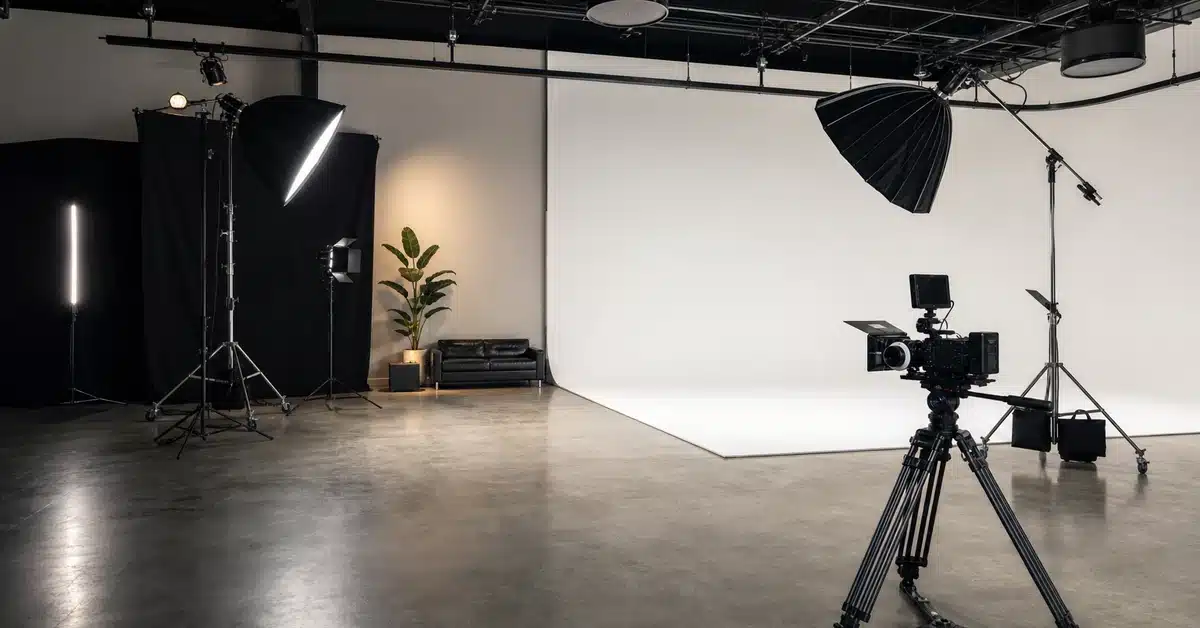
Locations bring texture and authenticity — the real brick, the real skyline, the real sunlight. But they also bring unpredictability. If the budget allows, shoot your performance sections in a studio and save locations for narrative scenes. A professional production facility with a full cyclorama wall and lighting grid — like the space at Lightz Out Studios — gives you the controlled environment that makes both approaches possible under one roof.
Pick the Right Partner, Not Just the Right Price Tag
The production company you choose will define how your music looks to the world — in search results, in social feeds, in the memories of fans who watch your video on repeat. The market is growing. The tools are more accessible than ever. What hasn’t changed is the simple truth that the best work comes from genuine creative collaboration between an artist and a team that believes in the vision.
If you’re an artist or producer in San Diego planning your next music video, reach out to Lightz Out Studios. The space is built for exactly this kind of work — professional lighting, a cyclorama wall, and a full production ecosystem that includes post-production through our sister studio, Pretzel Logic Productions, and integrated marketing support from InnoVision Marketing Group. Book the studio. Bring your crew. Make something worth watching twice.

