
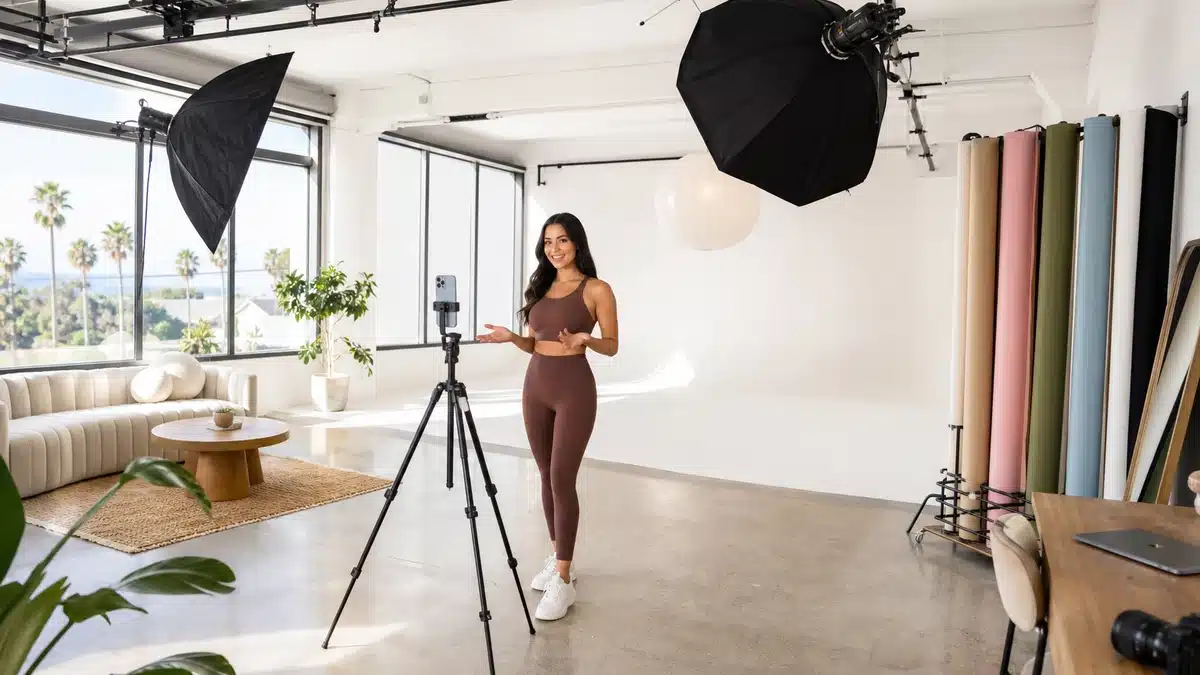
The gap between amateur-looking content and scroll-stopping professional content often comes down to one thing: where you shoot it. An instagram photo studio rental gives you access to professional lighting, clean backdrops, and a controlled environment that your apartment or makeshift home setup simply cannot match. For the same price as a nice dinner out, you can walk into a fully equipped production space and create content that looks like it came from a six-figure production budget.
Why Instagram Creators Are Moving to Professional Studios
The numbers tell a clear story. The global photo studio rental market hit $1.8 billion in 2025 and is projected to reach $3.6 billion by 2034, growing at an 8.1% compound annual rate, according to Dataintelo’s market analysis. Hourly rentals alone captured 42.3% of that revenue — nearly $761 million — driven overwhelmingly by freelancers, solo creators, and small teams looking for flexible, no-commitment access.
This is not a trend confined to commercial photographers. The unstaffed studio model — where creators book online, receive a door code, and walk into a fully lit, equipment-ready space — has gone mainstream. Circular Studios reports that content creation spending has now outpaced traditional photography spending across many markets, with YouTube, TikTok, and Instagram Reels driving more studio hours than portrait and product photography combined.
The Scroll-Stopping Production Value Gap
Instagram rewards visual quality. The algorithm may not explicitly measure production value, but your audience does. They decide in half a second whether to stop scrolling or keep moving. That decision — the difference between a swipe past and a follow — lives in lighting quality, background control, and visual consistency.
A professional photo studio gives you three things a home setup never will. First, lighting rigs that flatter faces and products in ways a ring light simply cannot. Second, clean backdrops and cyclorama walls that eliminate the “I shot this in my living room” look. Third, physical space — enough to pull back, shoot wide, and compose shots the way a professional would.
“Studio-based services still hold roughly 45% of the U.S. photographic services market,” notes Von Creative’s State of the Studio 2026 report. That figure holds because even in an era dominated by smartphone cameras and portable gear, controlled space remains the variable that separates amateur from professional output.
From Bedroom Setup to Brand-Ready Content
Here is what changes the first time you book an instagram photo studio rental. You stop editing around bad lighting. You stop cropping out the clutter in the background. You stop apologizing for the quality of your visuals.
Instead, you walk in, turn on the lights, and start shooting. Every backdrop is clean. Every light is positioned. The space is designed for exactly what you are trying to do. That efficiency compounds. A three-hour shoot in a professional studio produces more usable content than an entire weekend shooting at home — and it looks better.
Brands notice this, too. When your content looks professional, your rates can reflect it. The visual quality of your feed becomes part of your pitch, not a liability you hope prospective clients overlook. An instagram photo studio rental flips the dynamic — your visuals sell the work before you say a word.
What to Look for in an Instagram Photo Studio Rental
Not all studios are built for the same type of work. A space designed for commercial product photography may lack the flexibility a content creator needs to move between photo and video setups quickly. Here is what to evaluate before you book.
Space and Layout Essentials
Square footage matters less than usable shooting depth. A studio might list 1,800 square feet, but if half of it is storage or office space, your shooting area shrinks fast. Look for open floor plans with at least 15 to 20 feet of shooting depth — enough to pull back for full-body shots or group compositions.
Ceiling height is the spec nobody checks and everyone regrets ignoring. If you plan to use overhead lighting or boom stands, you need at least 12 feet of clearance. Circular Studios’ guide to first-time renter mistakes flags ceiling height as the number-one overlooked detail — along with forgetting to check for sound restrictions and underestimating setup and breakdown time.
Also check whether the studio has blackout capability. Natural light is beautiful, but if you need controlled lighting for consistent product shots or a specific mood, you need the ability to block the windows entirely.
Lighting and Equipment: What’s Included vs. What You Bring
The biggest variable across instagram photo studio rental options is the equipment inventory. Some studios provide a full lighting package — strobes, softboxes, C-stands, sandbags, and modifiers — included in the rental rate. Others offer a bare space and charge extra for every light and stand.
Before booking, ask for a current equipment list. Not the one posted on the website six months ago — a current one. Gear moves between shoots, gets damaged, or gets borrowed. LA Photo Party’s rental tips recommend confirming the equipment inventory the day before your booking because “gear gets moved between shoots.”
At minimum, a well-equipped studio for Instagram content should include continuous LED lighting (better for video than strobes), at least two to three modifier options, and enough grip gear to configure a standard three-point lighting setup without bringing your own stands.
Amenities That Save You Time
The difference between a good studio and a great one often comes down to what surrounds the shooting space. A client lounge lets you seat collaborators or clients while you set up. A makeup and changing station means talent can prep on-site instead of arriving camera-ready. On-site parking close to the entrance saves hauling gear across a parking lot.
That Toronto Studio’s rental evaluation guide emphasizes that the cheapest option is rarely the best value. A studio priced $30 less per hour but missing a changing room, a client lounge, or functional climate control costs you more in wasted setup time and shoot-day friction than you save on the rate.
Wi-Fi speed is another practical detail. If you are transferring files on-site, tethered shooting, or uploading content directly to Instagram during a shoot, slow Wi-Fi becomes a bottleneck. Test it during your walkthrough — not during the booking call.
How Much Does an Instagram Photo Studio Rental Cost?
Studio rental pricing varies dramatically by market, equipment level, and booking model. Knowing the landscape helps you avoid overpaying — or worse, booking a cheap space that costs you in production quality.
Hourly vs. Half-Day vs. Full-Day Rates
Hourly rates dominate the market. Market Intelo’s research shows hourly rentals command approximately 55% of total photo studio rental revenue — driven by freelancers, content creators, and small businesses who need flexible access rather than long-term commitments.
Expect to pay $75 to $200 per hour for a professional studio in a major U.S. market, with most well-equipped spaces clustering between $100 and $150. Half-day rates (typically four to five hours) range from $300 to $600. Full-day rates (eight to ten hours) run $600 to $1,200. Studios in prime urban locations — Los Angeles, New York, Miami — sit at the high end. Studios in secondary markets or suburban locations often price 20% to 30% lower for comparable spaces.

Hidden Costs First-Time Renters Miss
The listed rate almost never tells the full story. Equipment packages, backdrop changes, and overtime are the three biggest hidden costs. Some studios charge $25 to $50 per backdrop paper roll you use. Others bill overtime in 30-minute increments at 1.5 times the standard rate — and “overtime” starts the minute you exceed your booked window, not when you stop shooting.
Meet The Muse’s practical guide flags several questions every renter should ask before booking: Does the listed half-day mean four hours or five? Are weekend rates different from weekday rates? Is the cancellation policy forgiving if weather or talent cancels? And critically — what is included in the base rate versus what costs extra?
Always get the cancellation policy in writing. Some studios offer full refunds 48 hours out. Others keep your deposit regardless. Know which you are dealing with before you swipe your card.
How to Book the Right Studio (Step-by-Step)
Booking an instagram photo studio rental has gotten simpler — online platforms now account for nearly 60% of all studio bookings globally — but the evaluation step has gotten harder. More options in more markets means more variables to compare.
Where to Search
Peer-to-peer platforms like Peerspace, Giggster, and Splacer have become the default discovery layer for studio rentals. They filter by location, amenities, pricing, and reviews, and they handle booking logistics so you do not have to negotiate directly with studio owners.
Google Maps remains underrated. Search “instagram photo studio rental near me” and scan the results. Studios that show up on Maps are often locally owned, SEO-optimized spaces that offer better rates than platform-listed venues — the platform markup disappears. Photo Haus’s studio-finding guide also recommends searching Instagram location tags to see real shoots at candidate studios. A studio’s own marketing photos look perfect. Actual user-tagged content in the same space shows you what to really expect.
Local photographer Facebook groups and subreddits are another source of word-of-mouth recommendations — and sometimes shared rental deals where two creators split a full-day booking.
Questions to Ask Before You Book
Kelly Tareski Photography’s essential questions checklist hits the most important ones. What equipment is included versus rented separately? Are there noise restrictions — critical if you are recording audio for video content? What are the overtime policies if your shoot runs long? Is there on-site parking for your crew and talent? Can you visit the space beforehand?
Add a few of your own. Check the power situation — are there enough outlets near the shooting area, and are they on separate circuits? You do not want to trip a breaker mid-shoot. Ask about climate control, especially for long sessions in summer. And confirm the load-in logistics: elevator access, door width, and distance from parking to the studio floor all matter when you are hauling cases of gear.
First-Time Renter? Avoid These Mistakes
Everyone makes them. Here are the ones that cost you real money or usable content.
You book exactly the shoot duration with no buffer. Setup takes 30 minutes minimum. Breakdown takes 20. If you book a three-hour slot for a three-hour shoot, you are already behind before the first frame is captured. Always add at least one hour of padding.
You skip the walkthrough. Online photos are curated. Shadows, tight corners, and awkward power outlet placements do not show up in marketing galleries. Walk through the space first — or arrive 30 minutes early if this is your first booking at a new studio. Digital Love Studio’s expert tips recommend scouting the space beforehand or arriving early to test lighting setups before talent shows up.
You do not bring a shot list. Walking into a professional studio without a plan wastes the very thing you are paying for — controlled, efficient production time. Batch similar setups together. Pre-configure your lighting for each setup before your subject arrives. Kelly Tareski’s guide to maximizing rental studio time emphasizes pre-configuring lighting setups and batching similar compositions — it is the single most effective way to multiply usable output per paid hour.
You forget the small stuff. Extension cords. Gaff tape. Backup batteries. An extra memory card. None of these are expensive. Not having one when you need it can end your shoot.

Frequently Asked Questions About Instagram Photo Studio Rentals
What should I look for in an instagram photo studio rental?
Focus on three things: lighting quality, space flexibility, and included equipment. Professional continuous LED lighting is essential for video content. Look for at least 15 feet of shooting depth, a cyclorama wall or continuous backdrop system, and enough power outlets near the shooting area. Amenities like a changing room, client lounge, and climate control make long sessions productive rather than exhausting. Always confirm the current equipment inventory before booking — not what was listed six months ago.
How much does a photo studio rental cost?
Professional studios in major U.S. markets typically range from $75 to $200 per hour, with most well-equipped spaces clustering between $100 and $150. Half-day rates (four to five hours) run $300 to $600. Full-day rates (eight to ten hours) range from $600 to $1,200. Watch for hidden costs — backdrop changes, equipment add-ons, and overtime charges can add 20% to 40% to the base rate if you are not careful.
Do I need my own equipment when renting a studio?
It depends on the studio. Some spaces provide a full lighting package — strobes, softboxes, C-stands, modifiers — included in the rental rate. Others offer a bare space and charge separately for every piece of gear. Always ask for the included equipment list before booking. Even at well-equipped studios, bring your own camera, lenses, memory cards, and any specialty modifiers you rely on. The studio’s gear is a starting point, not a guarantee.
How far in advance should I book a studio rental?
For prime weekend slots in major markets, book two to three weeks ahead. Weekday availability is generally better — you can often book three to five days out. Peak seasons for studio rentals run September through December and February through April, when commercial and brand photography demand spikes. During those windows, studios with high occupancy rates fill up fast. If you have a specific date, do not wait until the week of.
Can I rent a studio for just one hour?
Most professional studios have a minimum booking of two to four hours. One-hour slots are rare because setup and breakdown time make shorter bookings unprofitable for studio owners. The four-hour minimum is the industry standard — it gives you enough time to set up, shoot multiple setups, and wrap without rushing. If you only need a quick session, some peer-to-peer platforms list micro-slots, but expect to pay a premium rate per hour.
What is the difference between a photo studio and a content studio?
A traditional photo studio is optimized for still photography — strobe lighting, backdrop systems, and tethered shooting workflows. A content studio is built for the modern creator workflow: continuous LED lighting suited for video, dedicated spaces for multiple camera angles, and amenities like ring light stations and phone-friendly tripod mounts. Many studios now blur the line between these categories, offering hybrid spaces that accommodate both photography and video production. When searching for an instagram photo studio rental, prioritize spaces that explicitly support video-ready lighting and quick set changes.
Get Professional Results Without the Overhead
You do not need to lease a warehouse or buy $20,000 in lighting gear to produce professional Instagram content. You need the right instagram photo studio rental for the hours you actually need it — and nothing more. That is the core value proposition of the modern studio rental model.
An instagram photo studio rental at Lightz Out Studios in San Diego gives you 1,800 square feet of production space, professional lighting, cyclorama walls, and multiple backdrop options — all included in the rate. Hourly bookings start at $125 with a four-hour minimum, and full-day sessions run $800 for a ten-hour block.
Book your session at lightzoutstudios.com or browse our headshot photography packages. Walk in. Turn on the lights. Shoot content that stops the scroll.
If your project calls for commercial video production or post-production support beyond the studio session, our sister studio Pretzel Logic Productions offers full-service commercial production on the same San Diego campus — same building, same ecosystem, complementary capabilities.

