
p>If you’ve ever tried to shoot product photography against a wrinkled bedsheet or spent an hour in post removing the seam where the wall meets the floor, you already know why a cyclorama studio rental changes the game. A cyclorama — or cyc wall — gives you a smooth, horizonless background that makes your subject the only thing the viewer sees. No corners. No shadows falling where they shouldn’t. No Photoshop gymnastics. For professional photographers, videographers, and content creators, booking a cyclorama studio rental isn’t a luxury. It’s the difference between work that looks amateur and work that looks finished.
What Is a Cyclorama Wall? (And Why It Changes Everything)
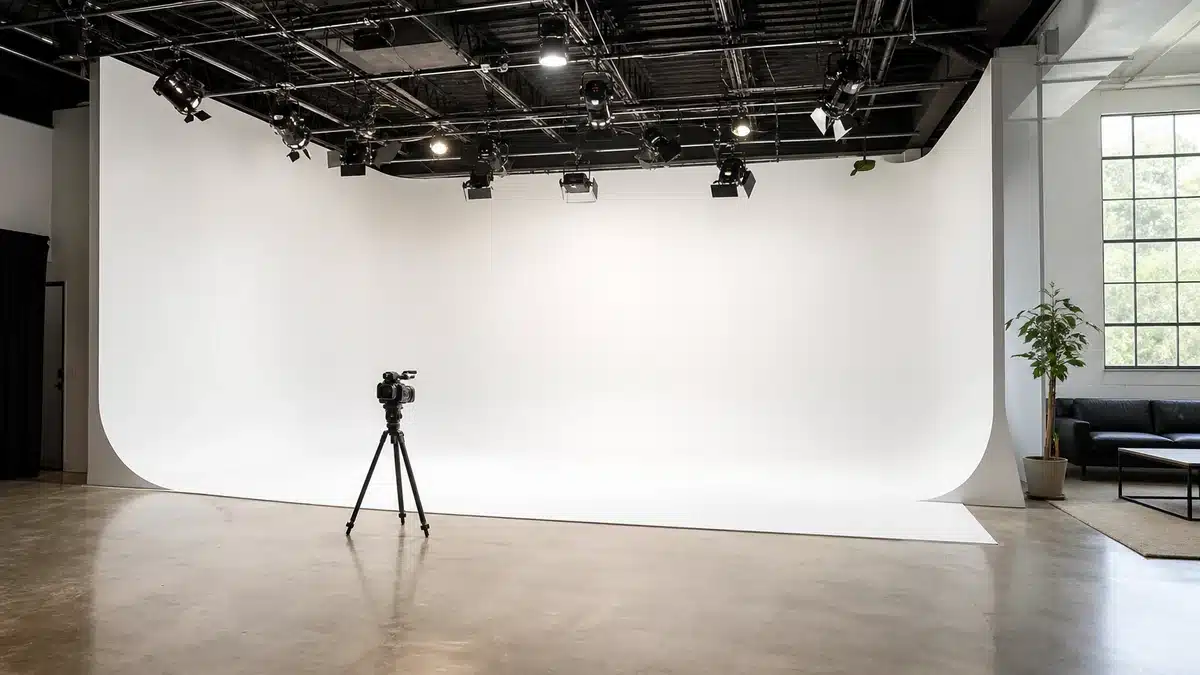
A cyclorama wall is a curved backdrop that blends the floor into the wall with no visible corner or horizon line. The curve — typically a 36-inch radius at the base — scatters light evenly and eliminates the hard shadow lines that flat backdrops create. The result is an illusion of infinite space behind your subject.
Walk into a well-built cyclorama studio and the first thing you notice is what isn’t there. There’s no corner behind your subject. No horizon line. Just space. For a photographer, that means clean wide shots without the visual clutter of baseboards, drywall seams, or backdrop stands creeping into the frame. For a videographer, it means camera movement — pans, dollies, gimbals — that doesn’t reveal the edges of the set. Apex Photo Studios describes their cyc walls as creating “the illusion of infinite space, eliminating horizon lines and shadows — perfect for photo and video production.” No backdrop paper or fabric setup comes close.
The Infinity Effect — How a Cyc Wall Eliminates the Horizon
The magic is in the curve. A proper cyclorama uses a radiused transition — usually 30 to 36 inches — between the floor and the vertical wall. Light hits that curve and rolls off gradually. Your eye can’t find a stopping point. The background just disappears. This is what makes a cyclorama studio rental fundamentally different from shooting in a rented conference room or a makeshift garage setup. The curve does the work that backdrop stands, seamless paper, and post-production cleanup can only approximate.
Farzan Samsamy Studio in Surrey, BC, engineered their cyclorama with a 12-foot by 24-foot stage and a 36-inch radius curve specifically designed for full-body movement-based shooting across both photography and cinematography. The radius matters. A tighter curve creates a harder transition and visible shadow lines. A generous radius — 30 inches or more — gives you the true infinity effect.
White Cyclorama vs. Green Screen — Which One Do You Need?
It depends on what you’re making. A white cyclorama gives you a clean, versatile canvas. Light it evenly and it’s a pure white infinity background. Color-wash it with gels and it becomes anything you need. It’s the standard for product photography, fashion lookbooks, corporate headshots, and music videos where a polished, commercial aesthetic matters.
Green screen cycloramas — like the one at MediaMix Studios in New Jersey, which operates both a 55-foot by 50-foot three-wall hard cyclorama with a 40-foot green wall and a smaller 34-foot stage — are built for compositing. You’re planning to replace the background in post. Some facilities, like Starr Street Studios in Brooklyn, offer nine cyclorama studios including both white cyc walls and pre-lit green screen stages so you can shoot plate shots and composable footage in the same session. If you’re unsure, book a white cyc. It’s more flexible. You can always hang a green backdrop on a white cyc. You can’t turn a green cyc white.

The Cyclorama Studio Rental Market Is Booming
The numbers are hard to ignore. DataIntelo reports the global photo studio rental market was valued at $1.8 billion in 2025 and is projected to reach approximately $3.6 billion by 2034 — growing at 8.1% annually. Studio rental specifically is the fastest-growing sub-segment of commercial photography, clocking a 16.4% CAGR as tracked by IBISWorld.
Something structural is happening here. It’s not just more photographers entering the market. The entire production ecosystem has shifted. The demand for a cyclorama studio rental is being pulled forward by changes in how brands produce content, how creators monetize, and how audiences consume visual media.
What’s Driving the Demand
Three forces are converging. First, short-form video production demand grew 340% from 2024 to 2027 driven by TikTok Shop, Instagram Reels, and YouTube Shorts. Brands that once shot 4 to 12 pieces of social content per month are now producing 28 to 65. That volume requires reliable, repeatable studio access — exactly what a cyclorama studio rental provides.
Second, 64% of CPG brands cut their in-house creative teams between 2024 and 2026, shifting $2.1 billion in production spend to outside studios and freelance crews, according to Forrester research cited by PulseRevOps. Those freelancers need space. They’re not signing five-year leases on commercial real estate. They’re booking cyclorama studios by the hour.
Third, hourly rentals now dominate the market at 42.3% of global revenue — roughly $761.4 million. Creators don’t want leases. They want a key and four hours of professional space. A cyclorama studio rental fits that booking model perfectly.
Market Numbers That Tell the Story
North America holds 34.7% of the global photo studio rental market. Medium studios — 600 to 1,800 square feet — capture 39.7% of revenue with daily rates between $850 and $2,200 in tier-one markets. That’s right where Lightz Out Studios sits: a 1,800 square foot facility in San Diego at $125 per hour with a 4-hour minimum. Competitive by any national benchmark.
The broader studio rental market — encompassing photo, video, and soundstage — reached $10.72 billion in 2024 and is expected to grow to $15 billion by 2035 at a 3.1% CAGR according to WiseGuyReports. The soundstage segment alone hit $2.8 billion in 2025 and is projected to reach $4.5 billion by 2034 at a 6.2% CAGR, with North America leading at 38.5% market share. Cyclorama-equipped spaces command a premium within that segment because the infrastructure investment is substantial and the creative output is visibly better.
Online booking platforms captured 58.4% of total photo studio rental bookings in 2025. Peer-to-peer aggregators like Splacer report year-over-year booking volume growth exceeding 19%. The friction of finding and booking studio space has dropped to near zero — and when friction drops, volume rises.
What to Look For When Renting a Cyclorama Studio
Not all cyclorama studios are created equal. Walk into three different facilities and you’ll find three very different shooting experiences. Here’s what separates a productive shoot day from a frustrating one.
Size and Ceiling Height — The Numbers That Actually Matter
Start with square footage and ceiling clearance. A 12-foot by 24-foot cyclorama with 12-foot side returns is engineered for full-body movement shots and cinematography. A 24-foot by 24-foot stage at Mainstage Chicago handles larger productions with crew and equipment — $150 per hour, $1,000 per half-day. Visualize Ventura Studios offers two sizes: a 50-foot wide Big Cove for car photography and large productions, and an 18-foot wide Small Cove for interviews, music videos, and fashion.
For most commercial work — product photography, fashion, music videos, corporate interviews — an 1,800 square foot space with adequate ceiling height gives you room to light properly without feeling cramped. If you’re shooting automotive or large set builds, you need more square footage. If you’re shooting talking-head interviews, you need less. Match the space to the project. Not the other way around.
Lighting Grid and Equipment — What Should Come Standard
An overhead lighting grid is non-negotiable for a cyclorama studio. It lets you rig lights above the subject without stands cluttering the floor. Revolt Camera in Toronto includes eight configurable Aputure Nova 600Cs with their cyclorama rental — a $1,200 full-day package. Manerk Studios in Southern California bundles Profoto D1 lights in their Pro and Max packages. CC Studios Miami provides continuous GVM LED plus Godox and Profoto options at rates from $110 per hour on weekdays.
Ask these questions before you book: Is the grid pre-rigged or do I bring my own grip? Are lights included in the rental rate, or is equipment a separate line item? What’s the power situation — standard outlets or three-phase? A studio that includes professional lighting in the base rate saves you hundreds in rental fees and an hour of setup and breakdown.
Amenities That Make or Break a Shoot Day
Look past the cyclorama itself. A client lounge matters when you’re shooting with a brand team or agency clients who need a place to sit that isn’t in your frame. A hair and makeup station — like the one at Revolt Camera — saves your talent from getting ready in a bathroom. Drive-in access and a loading dock change everything when you’re wheeling in cases of grip gear. Gigabit fiber internet, which Mainstage Chicago includes, is essential if you’re live-streaming or transferring footage during the shoot.
At Lightz Out Studios in San Diego, the 1,800 square foot space includes professional lighting rigs, multiple backdrop options, and a flexible open floor plan. It’s built for the working creative who needs to walk in, set up, and start shooting — not spend the first hour problem-solving the room. The San Diego location, shared with InnoVision Marketing Group and Pretzel Logic Productions, means creatives who book at Lightz Out have access to a full creative ecosystem — studio space, post-production, and campaign strategy — all on one campus.

How to Get the Most Out of Your Cyclorama Shoot Day
Booking the studio is the easy part. Making the most of your hours inside it takes planning. Here’s how to walk out with footage and photos you’re genuinely proud of.
Pre-Production Checklist
Scout the space if you can. If not, ask for a floor plan and lighting grid diagram before your shoot date. Know where the power drops are. Know what equipment is included and what you need to bring. Confirm the cyclorama’s condition — a well-maintained white cyc should be freshly painted and free of scuff marks. If it isn’t, you’ll spend your first hour in Lightroom cloning out shoe prints.
Build a shot list. A cyclorama is a blank canvas, which means it amplifies your creative choices — and your lack of them. Without a plan, you’ll burn time staring at a white wall. With a plan, you move efficiently from setup to setup. Group your shots by lighting configuration so you’re not tearing down and rebuilding between every frame. A cyclorama studio rental booked without a shot list is a cyclorama studio rental half-wasted.
Lighting a Cyclorama — The Core Techniques
Lighting the cyc is its own skill. The goal is even, shadowless illumination across the entire curved surface. The standard approach: position two or more lights on each side of the cyc, flagged to control spill onto your subject. Light the background separately from the foreground. This gives you independent control — you can make the background pure white for product photography, slightly gray for mood, or wash it with color using gels.
A common mistake: under-lighting the floor curve. The transition where the wall meets the floor needs extra attention, especially for full-body shots and wide compositions. If that curve isn’t evenly lit, the “infinity” effect breaks and you’re back to seeing a horizon line. Take the time to meter the floor separately. This is the detail that separates a professional cyclorama studio rental result from one that looks like it was shot in a white-painted garage.
Post-Shoot Workflow — Save Time in the Edit
A properly lit cyclorama studio rental reduces post-production to nearly zero for background work. That’s the whole point. If you lit it right, your subject pops against clean white. No masking. No clone stamp. No hours of cleanup. Use that saved time on the creative work — color grading, retouching, sound design — not fixing problems you could have solved on set.
One practical tip: shoot a reference frame of the empty cyc at each lighting setup before bringing your subject in. If you do need to extend the background in post, that clean plate is invaluable for content-aware fill and background extension.
Frequently Asked Questions About Cyclorama Studio Rentals
What is a cyclorama studio and how is it different from a regular photo studio?
A cyclorama studio features a curved wall-to-floor transition — usually a 30-36 inch radius — that eliminates the visible corner or horizon line. A regular photo studio typically has flat walls and floors that meet at a right angle, creating visible seams and shadow lines that require post-production cleanup. The cyclorama’s design creates the illusion of infinite space behind your subject, making it ideal for commercial photography, fashion lookbooks, music videos, and any project where a clean, professional background matters.
How much does a cyclorama studio rental typically cost?
Rates vary by market and studio size. Hourly rates range from $55 to $160 across U.S. markets, with half-day rates around $500-$1,000 and full-day rates between $800 and $1,750. Lightz Out Studios in San Diego offers competitive pricing at $125 per hour with a 4-hour minimum, or $800 for a full 10-hour day — learn more about the facility at the Lightz Out Studios website. Most studios include basic lighting equipment; premium gear packages may cost extra. Always confirm what’s included before booking.
What should I bring to a cyclorama studio rental?
Bring your camera, lenses, and any specialty gear the studio doesn’t provide. Confirm with the studio what lighting and grip equipment is included — many cyclorama facilities provide overhead grids, C-stands, and basic lighting. Bring backup batteries, memory cards, and a laptop for tethered shooting or on-site review. For video shoots, bring external audio gear unless the studio confirms in-house sound equipment. Wear clean, non-marking shoes — cyclorama floors show every scuff.
Can I paint or modify the cyclorama for my shoot?
Most studios do not allow clients to paint or permanently modify the cyclorama surface. However, some facilities — like Starr Street Studios in Brooklyn — offer the option to paint cycs to custom colors for an additional fee, coordinated through the studio staff. For temporary color effects, use gels on your background lights rather than physical modifications to the wall. Always discuss any special requirements with the studio before booking.
Do I need insurance to rent a cyclorama studio?
Most professional cyclorama studios require a Certificate of Insurance naming the studio as an additional insured party. This is standard practice across the industry. Lightz Out Studios requires COI for all bookings, as do most comparable facilities. If you’re a freelance creative without commercial insurance, some studios offer short-term production insurance options or can recommend providers. Check COI requirements before booking — it’s a common dealbreaker for first-time renters who assume they can walk in without coverage.
How far in advance should I book a cyclorama studio?
For weekend dates in major markets, book two to three weeks ahead. Weekday availability is typically better. If you need a specific date for a client project, lock it in as early as possible — professional studios in cities like San Diego, Los Angeles, and New York fill their calendars quickly during peak production seasons (spring and fall). Lightz Out Studios recommends reaching out early to secure your preferred time slot, especially for full-day bookings.
Book Your Next Cyclorama Studio Rental in San Diego
Lightz Out Studios gives San Diego creatives what they’ve been driving to LA for: a professional, fully equipped production space with competitive pricing and zero long-term commitment. The 1,800 square foot facility at 5797 Chesapeake Ct in San Diego includes professional lighting rigs, multiple backdrop options, and a flexible open floor plan that adapts to photo shoots, video productions, commercial projects, and creative content of any scale.
At $125 per hour with a 4-hour minimum — or $800 for a full 10-hour day — the rates are built for working photographers, videographers, and production teams who need professional infrastructure without the overhead of owning a studio. COI is required; the booking process is straightforward. For headshot photographers, the studio also offers dedicated professional headshot sessions in the same facility.
If your next project deserves better than a wrinkled backdrop and an afternoon of clone-stamping floor seams, book your cyclorama studio rental at Lightz Out Studios. Bring your vision. We provide the rest.

