
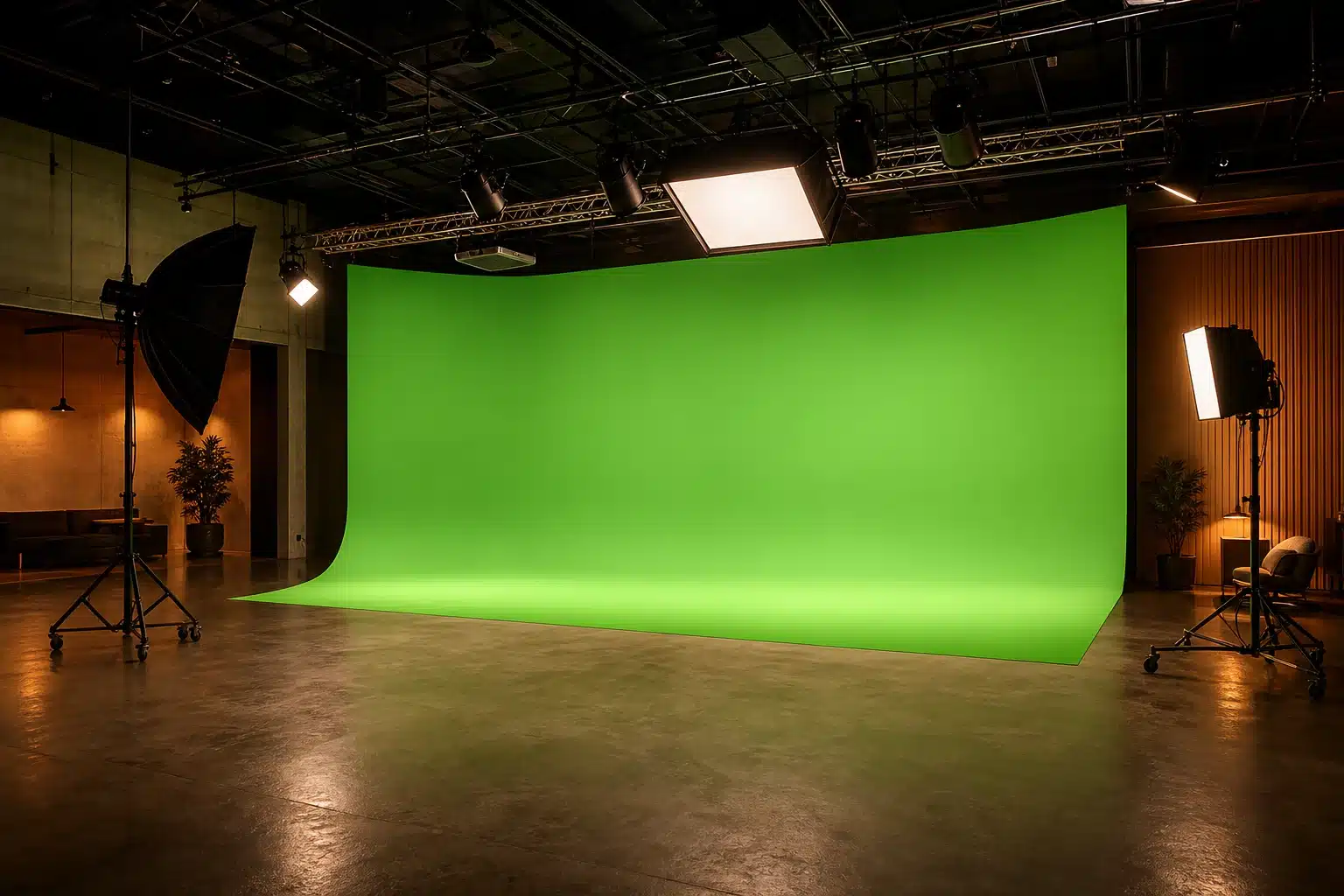
Green screen — or chroma key — replaces a uniform colored background with any image or footage in post-production. A well-lit, properly painted green screen gives you a clean key that drops out in one click. A mediocre one leaves matte lines, color spill, and hours of cleanup work in the edit. As MCM Stages puts it, “The better the stage, the cleaner the key, and the less time you spend fixing it in the edit.” The difference is the difference between a green screen studio rental that delivers clean compositing and one that eats your post-production budget in cleanup.
The numbers confirm what anyone booking shoots already suspects. The global studio rental market hit $9.2 billion in 2025 and is projected to reach $13.8 billion by 2034, growing at a 6.3% CAGR, according to Market Intelo. Film and video studios alone represent 35.2% of that market — roughly $3.24 billion. Green screen specifically commands 45.55% of the virtual production market, per Mordor Intelligence. Creators are moving away from scattered location shoots toward controlled environments that produce repeatable results. One session, dozens of deliverables. That is the math driving the entire shift.
Why a Green Screen Studio Beats Filming on Location
Location shoots have a romance to them. Morning light softening through a warehouse window. The texture of real brick. Environments that ground a scene in something authentic. They also have problems that eat production days one interruption at a time.
A crew shows up at 7 AM. Sunlight is perfect for about 45 minutes. Then a cloud banks in. Color temperature shifts by 800K. Wait. Rebalance. Shoot. Truck reverses into frame. Cut. Plane flies overhead. Reset audio. By noon, three usable shots exist and the rest of the day is a salvage operation. This is not an edge case — it is the median location shoot that is not on a closed set.
In a green screen studio, lighting stays consistent from the first take to the last. As Cineview Studios observes, “On location, the production adapts to the environment. In a studio, the environment adapts to the production.” No daylight loss. No public interference. No sound interruptions from adjacent businesses. The control a studio provides does not just reduce friction — it changes what is possible in a single rental window. Film a product demo at nine. A talking-head interview at eleven. A creative sequence with dramatic lighting at two. Same backdrop. Same setup. Three completely different final environments in post.
For brands and agencies producing consistent commercial content, that control converts directly to output. A green screen studio rental eliminates the travel costs, permit fees, and scheduling logistics that location shoots accumulate — which is why more commercial teams are booking green screen studio rental sessions as their default production approach. Cineview Studios frames it plainly: the studio lets you “create any background from a single location.” The creative flexibility is the pitch. The schedule reliability is what makes the budget hold.

What Separates a Professional Green Screen Studio from a Green-Painted Room
Not every space with a green wall qualifies as a green screen studio. The gap between a professional cyclorama stage and a flat painted wall is visible in the first frame of your edit.
A flat wall creates a visible seam where wall meets floor — a hard horizontal line that chroma key software has to fight. A proper cyclorama, or CYC wall, curves smoothly at that junction, eliminating any discernible edge. Killerspots Studio describes it directly: “A working green screen studio has a curved cyclorama where the wall meets the floor, eliminating the visible seam that flat painted walls produce.” That smooth curve is the first thing to look for when evaluating any studio. If it is not there, everything downstream gets harder.
Beyond the CYC wall itself, three other factors separate a studio purpose-built for production from a room that happens to be green.
Lighting Infrastructure
A grid-rigged or pre-lit studio saves more time than most first-time renters expect. Instead of spending 45 minutes setting stands, adjusting angles, and testing exposure, you walk into a space where key, fill, and backlight positions are already dialed in. Consistent, even illumination across the entire green surface is the single most important factor in getting a clean key. Uneven lighting produces color variation, and color variation produces hours of roto work or key-framing in post that a properly lit take would have avoided entirely.
100 Sutton Studios notes that pre-lit environments save time and resources: “Instead of spending hours rigging lights, adjusting angles, and testing setups, you walk into a space where lighting is already dialed in for optimal video production. The greenscreen studio’s consistent lighting ensures clean keying, reducing post-production headaches.” A studio that has already solved the lighting problem is a studio where the shoot starts the moment you arrive — not 90 minutes later.
Sound Isolation
A green screen studio worth booking is soundproofed. SE1 Studios describes the ideal as “a controlled filming environment, featuring a green backdrop designed specifically for chroma key compositions” where sound isolation keeps the recording clean. A space that shares a wall with an auto body shop or sits under a flight path is not a professional studio — regardless of how green the walls are. Soundproofing matters for music videos, corporate interviews, product demos with voiceover capture, and any production where clean audio is non-negotiable.
Ceiling Height, Power, and Practical Space
A green screen studio needs ceiling clearance for wide shots, boom mics, and backlight positioning. For any production involving full-body framing, dance sequences, or group setups, low ceilings become a hard constraint on what you can capture. Distributed power circuits are equally critical — a studio where lighting, camera, monitors, and client playback share a single 15-amp line is a breaker-trip waiting to happen mid-take.
Practical space between the subject and the green wall also matters. If the subject stands too close to the background, green light spills onto skin tones and hair — a color contamination effect that is notoriously difficult to correct in post. The best green screen studios give you enough depth to create meaningful separation between talent and the CYC wall. That distance is what keeps the key clean.
How Green Screen Powers Content Batching — One Shoot, a Month of Content
Here is the use case that turned green screen from “visual effects tool” into “default production method” for brands and independent creators: content batching. A single green screen studio rental produces footage that can be repurposed across backgrounds, formats, and platforms with no additional production days.
The Mix Post spells out the math: “From one shoot, you can create long-form YouTube videos, short social clips, training content, promotional ads, LinkedIn videos, and website videos — one session can easily provide a full month of content.” A corporate training module needs a clean office background in the edit. The same footage against a branded motion graphic becomes a social ad. A product walkthrough gets a studio backdrop for one platform and an animated environment for another. All from the same raw footage — shot in the same four-hour window.
This is not aspirational. The Source Magazine reported in 2026 that “a single 30-minute shoot can produce content for a dozen different campaigns, each with a different visual treatment in post. The shoot itself becomes a content factory rather than a single-use production.” For businesses and creators, that means one booking. One crew call. One post-production workflow. Assets that would have required multiple location days under the old model come out of a single session.
Xtreme Media frames the economic argument bluntly: “Why unnecessarily spend tens of thousands on complicated location shoots when versatile virtual set design options give you unlimited creative freedom at a mere fraction of the traditional cost?” The savings are not just in production dollars. They are in scheduling, crew availability, weather contingency, and the post-production complexity that location footage invariably introduces.
Creators who get this early build entire content calendars around a single studio day. The footage captured in one green screen studio rental feeds weeks of publishing across platforms — each cut looking like it was shot in a different location, because in post, it effectively was.

Green Screen vs. LED Volumes — What Creators Need to Know in 2026
The virtual production landscape is shifting fast. Green screen still dominates — 45.55% of the market as of 2025, with mature pipelines and widespread operator familiarity — but LED volume stages are advancing at a 31.48% CAGR through 2031, per Mordor Intelligence, and are projected to eclipse chroma key spend before the decade turns. For creators choosing a rental studio today, the question is not whether LED volumes are technically impressive. They are. The question is whether the cost premium makes sense for the project at hand.
LED volumes project the background in real time on massive LED walls, eliminating the chroma key step entirely. Actors see the environment they are performing in. Reflections and lighting interact naturally with the virtual set. No green spill to clean up. No matte lines to choke on hair detail. The trade-off is cost: premium sound stages with virtual production capabilities run $25,000 to $50,000 per day for top-tier facilities, according to Market Intelo. That is feature-film and AAA-game-trailer territory — not the budget range most commercial productions, music videos, or branded content shoots operate within.
Grand View Research projects the overall virtual production market to grow from $2.84 billion in 2025 to $12.25 billion by 2033 at a 20.4% CAGR. As that expansion continues, LED volume costs will come down and become viable for a wider range of productions. Until then, green screen remains the pragmatic choice. North America holds 40.55% of the virtual production market, meaning the infrastructure, the talent pool, and the studio availability are concentrated here — and most of that infrastructure is still green screen.
Green screen done well looks great. Green screen done poorly — matte lines, color spill, lighting mismatches between subject and the replacement background — looks worse than a simple real-world shoot. Audiences register the difference even when they do not articulate it. The deciding factor is the studio, the lighting, and the crew expertise. Not the technology itself. That has always been true.
Making the Most of Your Green Screen Studio Rental
Walking into a professional green screen studio without a plan wastes the main thing you are paying for: the controlled environment. Here is how to get maximum value from a single booking.
Pre-Production Is Where the Savings Live
Send your background plates or digital environments to your editor or VFX artist before the shoot. Confirm they key cleanly against test footage. A background that looks great as a still image can create compositing problems you do not want to discover after the shoot wraps. Lock your shot list and background assignments before you walk through the door. A green screen studio rental is a production environment, not a brainstorming session — every minute spent deciding what to shoot next is a minute of studio time you are not getting back.
Wardrobe Matters More Than You Think
Do not wear green. This seems obvious and still happens constantly. Avoid fine patterns — pinstripes, herringbone, tight plaids — which create moire artifacts on digital sensors. Avoid highly reflective clothing and jewelry that will catch the green spill and complicate the key. Solid colors in the blue, gray, black, and warm neutral families generally key cleanly. If the shoot involves multiple talent, coordinate wardrobe in advance so no one shows up in anything that will cause problems in post.
Build in Monitor Time
Review keyed footage on a monitor during the shoot — not afterward. The best studios provide a live chroma key preview so you can see the composite in real time. Hair light placement, subject-to-wall distance, and lighting balance are much easier to correct on set than in post. A ten-minute monitoring check after the first setup can prevent a full reshoot.
Over-Shoot Your Coverage
Record more angles than you think you need. The footage you capture in a green screen studio rental has a long shelf life — it can be re-composited against new backgrounds months from now for a different project. Wide, medium, and close-up coverage of every setup gives you options down the road. A tighter shot with clean framing can often save an otherwise unusable wide take.
Frequently Asked Questions
What should I look for when choosing a green screen studio rental?
Start with three things: the cyclorama wall quality (smooth floor-to-wall curve, professionally painted with chroma key paint), the lighting grid (pre-rigged or easily configurable, sufficient circuits), and the sound isolation (no adjacent noise sources, proper acoustic treatment). Ceiling height, parking access, available power, and practical depth between the subject position and the green wall are the next tier of considerations. A studio that gets all of these right is worth the booking. Ask for a walkthrough or recent production stills — a studio proud of its space will show it without hesitation.
Can I shoot a music video in a green screen studio?
Yes — and it is one of the most common uses of green screen studio rental. A single performance can shift between three or four completely different environments in the edit. The controlled lighting and sound isolation are particularly valuable for music video production, where sync playback timing and consistent exposure across performance takes are non-negotiable. Artists who book a green screen studio for music videos often walk out with enough footage for the official video, a lyric video, and several short-form social cuts — all from one session.
Do I need to bring my own equipment?
It depends entirely on the studio. Some provide cameras, lenses, lighting, and audio gear as part of the rental package. Others are dry hire — you supply everything. Ask specifically what is included and what costs extra before booking. Studios that offer in-house gear eliminate the logistics of coordinating with a separate rental house. Studios that also provide practical amenities — production kitchen, client lounge, on-site parking, climate control — reduce the number of external variables you have to manage on shoot day. A studio like Lightz Out Studios that offers a double cyclorama wall, full lighting grid, and on-site resources under one roof eliminates the fragmentation that forces creators to coordinate across multiple vendors.
How long does a typical green screen studio rental session last?
Most studios book in half-day (4-hour) and full-day (8- to 10-hour) blocks. A half-day suits a single setup with one or two background changes in post. A full day accommodates multiple setups, wardrobe changes, and enough coverage to produce several distinct deliverables. For content batching — where the goal is a month of content from one session — book the full day. The incremental cost of additional hours is almost always lower than the cost of scheduling a second booking and repeating the setup.
Does green screen still make sense with LED volumes becoming more common?
For most commercial, music, and branded content productions — yes. Green screen commands over 45% of the virtual production market and the cost gap between green screen and LED volumes remains significant. Premium LED stages cost tens of thousands per day. A green screen studio rental operates at a fraction of that, with established talent pipelines and decades of post-production tooling built around chroma key workflows. LED volumes will continue to grow. For productions that need professional results on a commercial budget in 2026, green screen is the right tool.
What kinds of content work best in a green screen studio?
Music videos, corporate interviews, product demos, social ads, training videos, YouTube content, and commercial brand campaigns all benefit from green screen production. Any project where the background needs to change between deliverables — or where the final environment must match brand guidelines precisely — is a strong candidate. Content that depends on naturalistic location texture and real-world spontaneity is better served by an on-location shoot. The decision comes down to whether the project needs control or authenticity in the final frame.
Ready to Book Your Green Screen Studio Rental?
A green screen studio rental gives you something no location shoot can match: control over the entire frame. The background, the lighting, the sound, the schedule — all of it becomes variables you set, not obstacles you navigate around. For creators and brands producing consistent, high-quality content, that control is not a luxury. It is the difference between output that looks professional and output that looks like a series of compromises stacked on top of each other.
If you are in San Diego and ready to book a full-production studio with a professional cyclorama wall, lighting grid, sound isolation, and everything your shoot needs under one roof, reach out to Lightz Out Studios to schedule your session. For corporate and commercial shoots, the studio operates alongside InnoVision Marketing Group — a full-service San Diego agency based on the same campus — providing end-to-end production support when your project needs more than just the space. One studio. Endless creative possibilities. Book your green screen studio rental and see what a controlled environment can do for your next project.

