
Here’s what the numbers tell you. Major-label music video budgets start around $20,000 and can blow past half a million. Meanwhile, independent artists are putting out compelling, watchable videos for $200 to $5,000 — sometimes less. Low-budget music video production isn’t about settling for less. It’s about understanding that a sharp concept, smart planning, and the right space produce better results than a blank check and a weak idea every time.
The artists you remember didn’t win because they spent more. They won because they had a better idea and executed it with whatever they had. This guide walks through the full low-budget music video production process from concept to final cut — without bleeding your bank account dry.
Why a Strong Concept Beats a Big Budget Every Time
Here’s a hard truth that most people learn the expensive way. A $500 video with a killer concept will outperform a $5,000 video with a boring one. Every time. No exceptions.
“If you have a small budget, you can’t get away with a mediocre idea,” notes the gigmit blog. “The more creative your idea is, the more attention you will get.”
Think about the low-budget music videos that broke through. OK Go on treadmills. Gotye painted body art in stop-motion. Alt-J’s “Breezeblocks” — one room, one take, backwards. None of these required deep pockets. They required an idea so specific and so well-executed that nobody thought about the budget.
The Sonicbids Blog puts it bluntly: the most memorable low-budget videos became iconic because the concept was clever, not because the production was expensive. So before you spend a dollar, spend time. Nail the idea. Everything else flows from there.
How to Develop a Budget-Proof Concept
Start with what you have, not what you wish you had. Inventory your resources first. Friends with interesting apartments. A vintage car. Access to a rooftop. A weird piece of clothing. The constraint forces creativity in a way unlimited resources never will.
Write down three concepts for your video. Cross out the one that requires the most outside help. Cross out the one that’s most similar to another artist’s video. The one that’s left — the most original, the most self-contained — is your starting point. This is low-budget music video production at its purest: creativity as currency.
The Gear You Actually Need (And What You Can Skip)
You don’t need a RED camera. You don’t need an anamorphic lens. You don’t need half the gear that rental houses will happily charge you for.
“A smartphone — iPhone 11 Pro or later, or a recent Android — paired with good natural light can outperform pricier gear with poor lighting,” according to ChangeLyric. That’s not marketing speak. It’s physics. A modern phone sensor in good light captures more usable dynamic range than a DSLR from five years ago. Production tools got cheaper, software got more powerful, and cameras got smarter — the gear gap between you and a professional shoot has never been smaller, and it keeps shrinking with every new phone release.

The Essentials List
Your camera — whatever you already own or can borrow. A tripod — non-negotiable, shaky footage screams amateur before the first note plays. One good lens if you’re on a DSLR or mirrorless system. A variable ND filter if you’re shooting outdoors during daylight. That’s the core kit. Everything else is optimization.
The Agicent team frames it well: achieving polished results now depends more on planning, technical control, and efficient asset management than on expensive gear. When you’re deep in low-budget music video production, that mindset is your most valuable asset.
What You Can Borrow, Rent, or Skip
Gimbals are rental items. Sliders too. Specialty lenses — rent them for the shoot day, don’t buy them for one video. Lighting is where you should actually spend, and we’ll get to that next.
How to Light a Music Video Without a Pro Lighting Budget
Lighting is the one place where cutting corners shows. Bad light makes a $10,000 camera look like a webcam. Good light makes a phone camera look cinematic. The good news? You can get there without a grip truck.
Start with what’s free. A large window at the right time of day. Bounce cards — a $5 sheet of foam core from any art store. Practical lights already in the room. The FILMPAC case study with Shy Honey’s “Potion” video proves the point: a one-day shoot with minimal lighting, prioritized around performers, setting, and wardrobe, delivered a polished result that looked far more expensive than it was.
The Affordable Lighting Kit
One key light. One fill source — could be a bounce card, could be a second cheap LED panel. One backlight to separate your subject from the background. Three-point lighting isn’t expensive when you build it from affordable LEDs. This is what separates amateur low-budget music video production from work that looks professional.
The ChangeLyric guide puts natural light at the top of the list for good reason. Shoot near a large north-facing window. Position your subject so the light falls across them at an angle, not flat. Add a bounce card on the shadow side. You’ve just lit a scene for the cost of poster board.
Location Hacks: Cinematic Backdrops That Don’t Cost a Dime
The most cinematic locations in your city cost nothing. Rooftops at golden hour. Concrete stairwells with interesting geometry. Empty parking structures. An alley with one good painted wall. A friend’s apartment with floor-to-ceiling windows.
In fact, one strong visual element or motif can keep an entire music video engaging without heavy props or effects, as the DIY Musician guide from CD Baby points out. Pick one striking backdrop. Build the video around it. Let the location do the heavy lifting.
What to Look For in a Free Location
Texture. Interesting light. Depth — a space you can move the camera through, not just a flat wall. Power access if you need lights. Permission — always get it, ideally in writing. Sound control if you’re recording live audio. And a backup plan in case you get kicked out.
The gigmit guide emphasizes starting with a budget-aware concept that maximizes what you already have. That includes locations. Your friend’s apartment with good light. Your drummer’s warehouse rehearsal space. The parking garage of your day job after hours. Low-budget music video production means seeing every ordinary space as a potential set.
Shoot Day Strategy: How to Get Maximum Footage From Minimum Time
Time is the hidden cost of every shoot. The longer you shoot, the more you spend — on location, on gear rental, on feeding people, on your own energy. A tight shoot day is a cheap shoot day.

A single filming session can provide material for a full-length music video, short promotional clips, behind-the-scenes content, teasers, and release-day assets across multiple platforms, according to iMusician. The key is planning — not winging it.
The Pre-Production Checklist
Shot list. Printed. With backups for every shot. Call sheet with arrival times, parking info, and one contact number. Batteries charged the night before — all of them. Memory cards formatted and tested. Snacks and water — hungry crews get slow and cranky.
The Moozix Blog describes a disciplined playbook you can repeat, adjust, and scale. Start with a one-page story capturing the emotional arc and a single visual hook. That one page becomes your north star when things inevitably go sideways on set.
Why Structure Saves Money
Every unplanned minute on set costs you. You’re either paying for studio time or losing daylight. Block your day in sections: setup, performance takes, b-roll, detail shots, wild audio. Move fastest through the sections that require the most crew coordination. Save solo detail shots for the end when everyone else can wrap. Disciplined low-budget music video production runs on structure, not inspiration.
Editing on a Budget: Software and Workflow That Deliver
Free editing software has never been better. DaVinci Resolve’s free tier includes professional color grading, Fusion visual effects, and Fairlight audio — tools that would have cost thousands five years ago. CapCut handles quick social cuts. iMovie ships on every Mac. You have options.
“To create a quality music video, filling even just two or three minutes can require a surprising amount of footage,” notes iMusician. This is where organization pays off. Label your clips as you import them. Build a rough assembly first — full song, best takes. Then cut it down. Don’t start with fine edits on individual shots. You’ll burn hours on transitions for shots that won’t survive the assembly pass.
The Three-Pass Edit
Pass one: assembly. Every usable take, in order, synced to the track. Don’t judge anything yet — just get it on the timeline. Pass two: the real cut. Ruthless trimming. If a shot doesn’t serve the song, it’s gone. Be brutal here. Pass three: polish. Color grade, stabilization, subtle transitions. Now you can obsess over the details that actually show on screen.
How Professional Studio Rental Can Save You More Than It Costs
Here’s the counterintuitive truth about low-budget music video production. Renting a professional studio often costs less than piecing together a DIY shoot.
Add up the hidden costs of shooting in a free location. Equipment rental for lights you don’t own. Backdrop stands. Extension cords. Sandbags. Gaffer tape. Gas money for location scouting. The half-day you lose to bad weather. The shot you can’t get because the ceiling is too low or the outlets are in the wrong place.
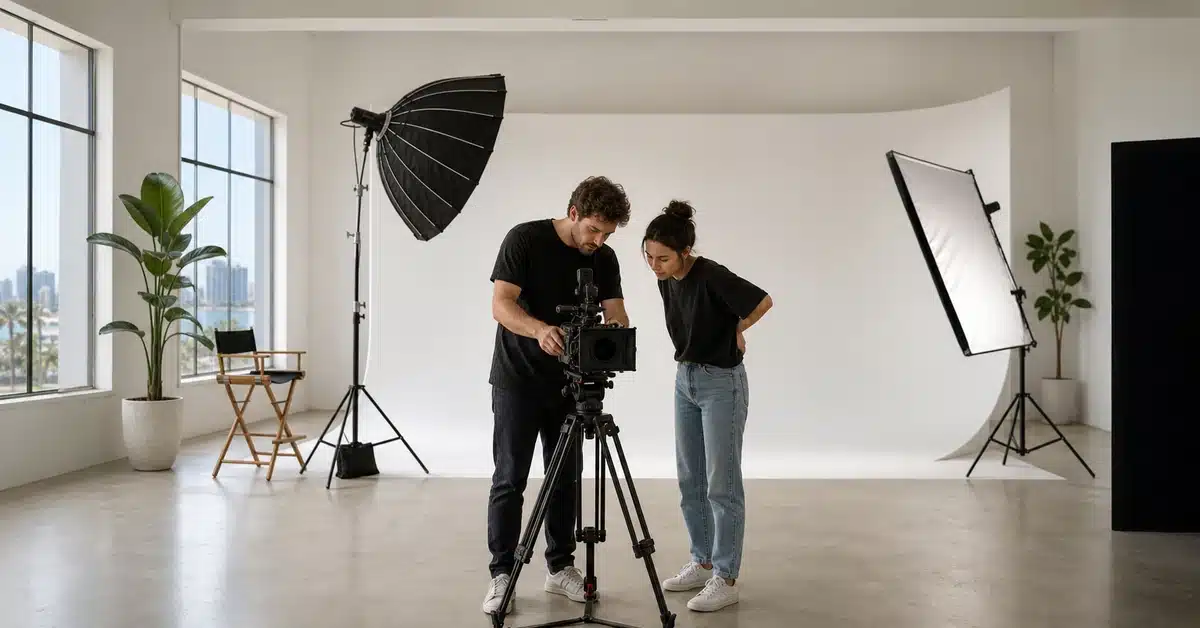
A turnkey studio eliminates all of that. Built-in lighting grids. Cyclorama walls. Professional backdrops. Climate control. Power exactly where you need it. Bathrooms.
Lightz Out Studios in San Diego offers exactly this model — 1,800 square feet of professional production space at $125 an hour with a four-hour minimum, or $800 for a full ten-hour day. That includes professional lighting, multiple backdrops, and full production infrastructure. For the cost of renting a mid-range lens kit for a weekend, you get a professional environment where you control every variable. This is what smart low-budget music video production looks like: spending where it multiplies, not where it adds.
The Time Warner Entertainment guide demonstrated this with a $4,000 total budget shoot — studio space plus smart planning produced a result that looked like five times the spend. Their key insight: the room itself does half the work.
When the Studio Math Makes Sense
You need a controlled environment for performance shots. You’re shooting with more than two people. You need consistent lighting across multiple setups. You want a cyclorama or a clean, professional backdrop without seams or gaps. You can’t afford a weather cancellation. Any two of those — the studio pays for itself.
Even the most resourceful DIY filmmakers hit a wall. The Musician.ie low-budget guide breaks down real costs: camera hire at €50-150 a day, location fees anywhere from free to €200, lighting at €50-100, and editing at €100-300. When you tally those — plus the time and stress of coordinating them separately — an all-inclusive studio starts looking like the smartest line item in your low-budget music video production budget.
Frequently Asked Questions About Low-Budget Music Video Production
How much does a low-budget music video actually cost?
The range is wider than most people expect. Independent artists routinely produce videos between $200 and $5,000, according to iMusician. At the bottom end, a single-location shoot with borrowed gear and a friend behind the camera can come in under $300. A studio day with professional lighting and a small crew typically lands between $2,000 and $4,000. The number that matters isn’t the total — it’s what you get per dollar spent.
Can I really shoot a professional music video with my phone?
Yes. A recent iPhone or high-end Android in good light produces footage that holds up on YouTube and social platforms. Mount it on a tripod. Control your exposure manually — use an app like FiLMiC Pro or Blackmagic Camera. Light the scene. The difference between phone footage and cinematic phone footage is almost entirely lighting and stability, not sensor size.
How long does a music video shoot take?
A single-location performance video can shoot in four to six hours. Multiple locations or narrative concepts typically require a full day — eight to ten hours. The CD Baby guide recommends planning a quick shoot with setup and teardown built into the timeline. Rushing causes mistakes. Padding the schedule with buffer time between setups is the cheapest insurance you can buy.
What should I spend money on if my budget is tight?
Lighting first. Location second. Audio sync gear third — even if you’re not recording final audio, a clapper or sync waveform saves hours in post. After that, a good tripod. Most other gear can be borrowed, rented, or worked around. As Orphiq puts it, a well-conceived concept and efficient planning outperform a bigger budget with a weak idea.
Do I need a studio for a music video?
Not for every concept. But if your video involves multiple setups, controlled lighting, more than two performers, or any kind of professional backdrop — a studio eliminates the variables that kill low-budget shoots. For artists and teams in San Diego, Lightz Out Studios provides a fully equipped space — lighting grid, cyclorama, 1,800 square feet — at rates that make the math work for indie productions.
How do I make a low-budget video look expensive?
Three things. Control your light — soft, directional, intentional. Keep your framing deliberate — no accidental headroom, no crooked horizons. And limit your color palette — in wardrobe, in location, in grade. The Native Instruments guide frames it well: music videos can be experimental films, visual stories, or a series of images that capture a mood. All of that can be done cheaply. What can’t be faked is intentionality. A cheap video that knows exactly what it is will always outrun an expensive one that doesn’t.
Bring Your Vision to Life — Without Breaking the Bank
Low-budget music video production is a creative constraint, not a creative limitation. The tools are cheaper than they’ve ever been. The knowledge is free. What separates a forgettable low-budget video from one people share is the same thing that always has — a strong idea executed with precision.
Nail the concept first. Light it well. Plan your shoot day like you’re spending real money — because you’re spending real time. And when the logistics of location scouting, equipment rental, and weather contingency start eating into your creative headspace, consider the counterintuitive option: a professional studio that bundles all of that into one predictable cost.
Lightz Out Studios in San Diego gives you the space, the lights, and the infrastructure. You bring the idea. Book by the hour or grab a full day. Either way, you’re spending your energy where it belongs — on the creative work, not the logistics. That’s the real difference between a video that looks like it cost nothing and one that looks like it cost a fortune.

