
When you search for a portrait photography studio near me, you are making a bet on how the world sees you. A professional portrait is not just a photo. It is the image that appears on LinkedIn before a recruiter finishes reading your name. It is the thumbnail casting directors scroll past at two per second. It is the face your business presents on its About page, speaking before a single word of copy lands.
And here is the thing most people miss: the studio matters as much as the photographer. Lighting, space, backdrops, even the quality of the air in the room — every variable shapes the final image. A cramped home office with a ring light cannot produce what a purpose-built professional studio can.
This guide walks you through exactly what to look for, what to expect, and how the industry itself is evolving. By the end, you will know how to pick the right portrait photography studio near you — and why that decision changes the quality of the image you put into the world. A portrait photography studio near me is not a commodity purchase; the space, the gear, and the expertise vary wildly from one studio to the next.
What Defines a Professional Portrait Photography Studio
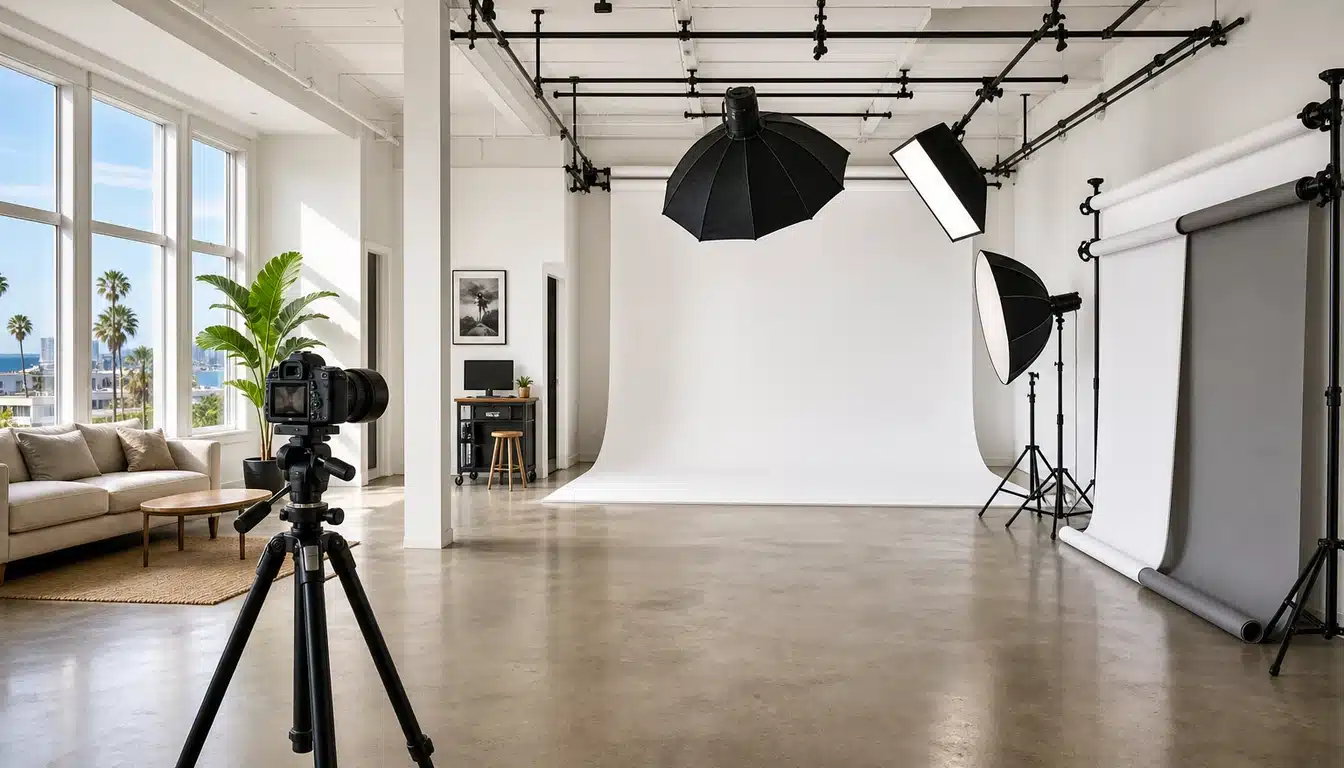
The foundation is the space itself. When you visit a portrait photography studio near me, the first thing you should notice is the room — ceiling height dictates how high lights can be positioned. Square footage determines whether a full-body portrait is possible or whether the photographer is backed against a wall. Professional studios run from about 800 to over 2,000 square feet — enough room to create separation between subject and backdrop, which is critical for depth of field and lighting control.
Then comes the lighting grid. A serious studio has ceiling-mounted rails or a truss system that lets lights be positioned anywhere in the room without stands cluttering the floor. Softboxes, beauty dishes, strip lights, and hair lights all serve different purposes. A studio equipped with a full lighting arsenal gives the photographer options a single speedlight on a stand cannot touch, as explained in the complete guide to portrait photography essentials from FD Photo Studio.
Backdrop variety is the third pillar. Every professional studio should offer continuous-roll backdrop paper in white, gray, and black at minimum. Better studios add hand-painted canvas backdrops, textured walls, and furniture for lifestyle portrait setups. The difference between a single gray backdrop and six options is the difference between one look and a portfolio of distinct images from the same session.
Lightz Out Studios, at 1,800 square feet in San Diego, checks all three boxes: ceiling-mounted lighting rigs, multiple backdrop configurations, and a cyclorama wall for clean, shadow-free full-body portraits. That kind of infrastructure cannot be replicated at home, no matter how good your camera is.

Key Equipment Every Portrait Studio Should Have
Walk into any portrait photography studio near me and look for these five things before you book.
Lighting: More Than One Source
A single light produces flat, shadow-heavy images. A proper key light with fill and hair lights creates dimension — the subject pops off the background instead of blending into it. Studios running four or more strobes with modifiers give the photographer the control needed for commercial-grade portraits. Manfrotto’s studio portrait photography guide walks through exactly how multi-light setups create professional depth that single-source lighting cannot match.
The Cyclorama Wall
A cyclorama — a curved wall where the floor curves into the wall without a visible seam — eliminates the horizon line. No seam, no corner shadow, just a smooth infinite background. This is a premium feature. Studios that invest in a cyc wall are signaling they are built for commercial work, not hobbyists.
Professional Camera Systems
Full-frame DSLR or mirrorless systems with fast prime lenses (85mm f/1.4, 70-200mm f/2.8) are the portrait photography standard. The lens matters more than the body — an 85mm at f/2.0 produces the shallow depth of field that separates a professional headshot from a smartphone selfie. Tethered shooting capability, where images appear on a large monitor in real time, lets both photographer and client review shots as they happen rather than discovering issues after the session ends.
Grip and Support
Heavy-duty C-stands, sandbags, boom arms, and apple boxes. If a studio has lightweight consumer tripods on the floor rather than professional grip equipment, that says something about the level of work they are built for. Good grip gear means the photographer can position lights and modifiers precisely without worrying about equipment tipping over mid-shoot.
Tethering and Review Station
A dedicated monitor on a rolling cart or wall mount, connected to the camera via cable. This is the single most overlooked feature by consumers but the one that most reliably separates amateur sessions from professional ones. When you can see each image full-size moments after it is captured, you can adjust your expression, posture, and wardrobe in real time. The final selects are stronger because the feedback loop is instant.
Future Digital Studio’s breakdown of quality consistency in portrait studios highlights why equipment standards directly translate to predictable, professional output across every session.
How to Evaluate a Portrait Studio Before Booking
You can learn everything you need to know about a studio in ten minutes if you know what to check. Here is the evaluation framework.
Start with the portfolio. Not the highlight reel on Instagram — the full galleries on the actual website of the studio. Ask yourself: do the portraits look like the same person photographed in different ways, or do fifty different people all look like variations of the same image? The first is a photographer who adapts to their subjects. The second is one who shoots a template. You want the first.
Look at the eyes. In a well-lit portrait, the catchlights — the tiny reflections of the light source in the eyes of the subject — should be clean and intentional. Irregular catchlights suggest haphazard lighting. No catchlights at all means the photographer lit from an odd angle or relied entirely on ambient light. Both are red flags.
Then check the space. A studio website should show photos of the actual studio — not a generic stock image of a photography studio. Look for ceiling height (low ceilings limit lighting options), visible backdrops, and evidence of professional grip equipment. PhotographyTalk’s design guide lists the five elements that distinguish a working professional space from a converted spare room.
Read reviews with a specific lens: ignore the five-star raves and look at the three and four-star ones. Every portrait photography studio near me has a mix of ratings — the only question is whether the critical reviews reveal a pattern or a one-off issue. Those are where people disclose what actually happened — the session ran long, the turnaround was slow, the photographer seemed rushed. Pattern recognition across reviews tells you more than any portfolio image can.
Finally, ask about the studio’s insurance and COI policy. This sounds administrative, but it is a reliable signal. Studios that require certificates of insurance and maintain their own coverage are operating at a professional, commercial level. Studios that treat insurance as optional or irrelevant are not. This distinction alone filters out most amateur operations, as LIOP’s studio operations guide confirms — professional liability coverage is a defining line between hobbyist spaces and commercial studios.
The State of the Portrait Photography Industry
The numbers tell a story of growth and consolidation. The portrait photography studios segment in the United States reached nine billion dollars in revenue in 2025, growing at five point two percent annually, according to Kentley Insights’ 2025 industry report. Globally, the portrait photography services market generated sixteen point seven billion dollars across 195 countries.
There are 17,031 portrait photography studio businesses in the U.S., but the top four companies hold 38.4% of the market. That means when you type portrait photography studio near me into a search bar, the vast majority of studios that appear are independent operations competing on quality and service, not corporate chains. The average revenue per location is roughly four hundred thousand dollars, with revenue per employee around ninety-nine thousand dollars. These are not hobby businesses. They are operational enterprises. When you search for a portrait photography studio near me, the ones that show up at the top of results are the ones that treated the business side seriously from day one.
The labor side is tightening. The Bureau of Labor Statistics index for portrait studio labor compensation rose to 127.741 in 2025 from 120.895 in 2024 — a 5.7% increase — while total hours worked in the sector dropped slightly from 81.5 million to 78.5 million, per Federal Reserve economic data. Fewer hours worked at higher wages per hour: the industry is professionalizing, not expanding at the low end.
ShootProof’s State of the Photography Industry 2025 report adds texture: portrait sessions were up thirty-five percent in 2024, even as wedding photography dropped nearly fifty percent. Photographers are diversifying. About ten percent now operate across multiple business models — weddings, portraits, commercial work — rather than betting on a single revenue stream. And between sixty-five and seventy-seven percent of photographers reported increased business costs while pricing failed to keep pace, pushing studios toward efficiency and upsell strategies. Face-to-face product sales boost revenue by thirty-three percent for client-based photographers; viewing appointments alone add twenty percent.
A portrait photography studio near me that understands these trends — one that treats the business as a business, not a side hustle — is the one worth your money.
What to Expect During a Professional Portrait Session
Knowing what happens eliminates the anxiety most people feel walking into a studio. If you have never booked a portrait photography studio near me before, understanding how a session unfolds will change your experience from nerve-wracking to genuinely enjoyable.
You arrive and check in. The photographer or studio manager reviews the plan: how many looks you booked, what wardrobe changes are queued, any specific requests. They may offer a mirror and a steamer if your clothes traveled in a bag. This is not a rushed process — good studios build buffer time into every booking.
The photographer positions you on the mark, adjusts the key light, and takes test frames to dial in exposure. This takes five to ten minutes. If the photographer skips this step and starts shooting immediately, they are guessing. Test frames are the sign of a pro who wants the lighting right before the real images begin.
Then the session itself. A good portrait photographer talks through the entire thing — directing your chin angle, where to look, what to do with your hands. They should show you images on the tethered monitor periodically so you can see what is working. The feedback loop builds trust. You start to relax around frame twenty. By frame fifty, you have forgotten the camera is there. That is when the best portraits happen.
SLR Lounge’s complete guide to posing covers the subtle adjustments — jaw forward, shoulders back, weight shifted to the back foot — that separate an amateur snapshot from a professional portrait. The photographer should be guiding you through these continuously, not just triggering the shutter in silence.
After the session, expect a selection process. Some studios let you review and choose on the spot. Others send a proof gallery within 24-48 hours. At a portrait photography studio near me, retouching timeframe varies: standard turnaround is three to seven days for a small set of final selects. Rush delivery costs extra and should be discussed before booking.
Why Professional Studio Portraits Beat DIY and AI Alternatives
AI headshot generators have flooded the market. Upload ten selfies, pay thirty bucks, and receive a hundred AI portraits. The results look polished at thumbnail size. They fail the moment anyone looks closely.
AI cannot replicate lighting that flatters your specific face shape. It cannot read your expression in real time and tell you to drop your chin half an inch. It cannot create genuine catchlights that make your eyes look alive rather than flat. And it certainly cannot make you feel relaxed and confident during a session — which is half of what produces a great portrait to begin with.
The DIY alternative to a portrait photography studio near me — a friend with a decent camera or a tripod and a timer — has the same structural problem: lighting. Without studio strobes positioned precisely, your portrait will look like what it is. A photo taken in a room, not a portrait made in a studio. The color temperature will be off, the background will be distracting, and the depth of field will be either too shallow or too deep. There is a reason studios like Boston Portrait and Executive Lens build their entire business around controlled studio environments — the studio is the product as much as the photographer is.
A professional portrait photography studio near me represents something AI and DIY cannot offer: expertise applied in real time. The photographer sees things you do not — a collar that went crooked, a stray hair catching light, a shadow falling across half your face. They fix these before the shutter fires. AI fixes them after, badly. That is the difference.
Benjamin Edwards’ behind-the-scenes look at portrait studio setup shows exactly how many small decisions — light placement to the inch, modifier choice, backdrop distance — go into a single professional portrait. None of those decisions exist in an AI pipeline.
Questions to Ask Before Booking Your Session
Show up to your inquiry call prepared. These six questions separate professionals from amateurs faster than any portfolio review.
How many lights do you typically use for a portrait session? The answer should be three or more. Key, fill, hair light, and optionally a background light. If the answer is one or two, ask whether they can add more for your session.
Do you shoot tethered? If no, the photographer is reviewing images on a three-inch LCD screen. That is fine for casual work. It is not fine for a professional portrait where small details matter.
What is your retouching policy? Some studios include basic retouching (blemish removal, color correction). Others charge per image. Clarify before booking so you are not surprised by a post-session invoice. Every portrait photography studio near me handles retouching differently, and clarifying this upfront avoids the most common booking regret.
How many final images do I receive, and in what format? Most portrait sessions deliver five to twenty retouched images as high-resolution JPEGs. Raw files are almost never included — that is industry standard, not a red flag.
What is your turnaround time? Standard is three to seven business days. Anything faster is a bonus. Anything longer without an explanation is a warning.
Can I see the studio before booking? Serious studios say yes. If the answer is no — if the photographer is evasive about the space — they are likely operating out of a living room or a rented conference room. That may still produce decent images. But you deserve to know what you are paying for.
Kitta Bodmer Photography’s Portland studio illustrates what transparency looks like — the space is front and center on their site, with clear session descriptions and an explicit what-to-expect page. That is the standard to hold studios to.
Frequently Asked Questions
How much does a professional portrait session cost?
Portrait photography studio sessions in the U.S. typically range from two hundred to six hundred dollars depending on session length, number of looks, and retouching included. The national median sits around two hundred fifty dollars according to industry surveys. Specific pricing depends on your market — studios in major metro areas run higher than smaller cities. Always confirm what is included before booking.
How long does a portrait photography session take?
Most professional portrait sessions run 45 to 90 minutes. A single-look headshot session can finish in 30 minutes. Multi-look sessions with wardrobe changes and different backdrops extend to 90 minutes or more. The studio should tell you the planned duration when you book.
What should I wear to a portrait session?
Solid colors photograph better than patterns. Avoid large logos, busy prints, and pure white (it blows out under studio lights). Bring two to three outfit options — one formal, one business casual, one that reflects your personal style. The photographer can help you choose once you arrive. Iron or steam everything before the session.
How often should I update my professional portrait?
Every two years for most professionals, or sooner if your appearance changes meaningfully — a new hairstyle, significant weight change, or age progression that makes your current photo no longer look like you. Actors and on-camera professionals should update every 12 to 18 months.
Can I bring my own props or wardrobe to the studio?
Yes. Most professional portrait studios encourage you to bring props and wardrobe that reflect your personality or profession. A chef might bring their knife roll. A musician might bring their instrument. Just coordinate with the photographer ahead of time so they can plan the lighting and composition around your items.
What is the difference between a headshot and a portrait?
A headshot is a tightly framed photograph — head and shoulders only, typically from the chest up. It serves a specific professional function: casting submissions, LinkedIn profiles, company directories. A portrait is broader — it can be half-body, three-quarter, or full-body and includes more environmental context. Portraits allow more creative expression. Many sessions include both.

For San Diego professionals and creatives, Lightz Out Studios offers an 1,800-square-foot professional production space with ceiling-mounted lighting, a cyclorama wall, and multiple backdrop configurations — purpose-built for portrait photography at a commercial level. Book a session to see the difference a professional studio makes in person, or visit the headshots page to explore portrait and headshot packages.

